PM YASASVI Scholarship 2026-27: OBC, EBC, DNT Eligibility & Last Date
Introduction
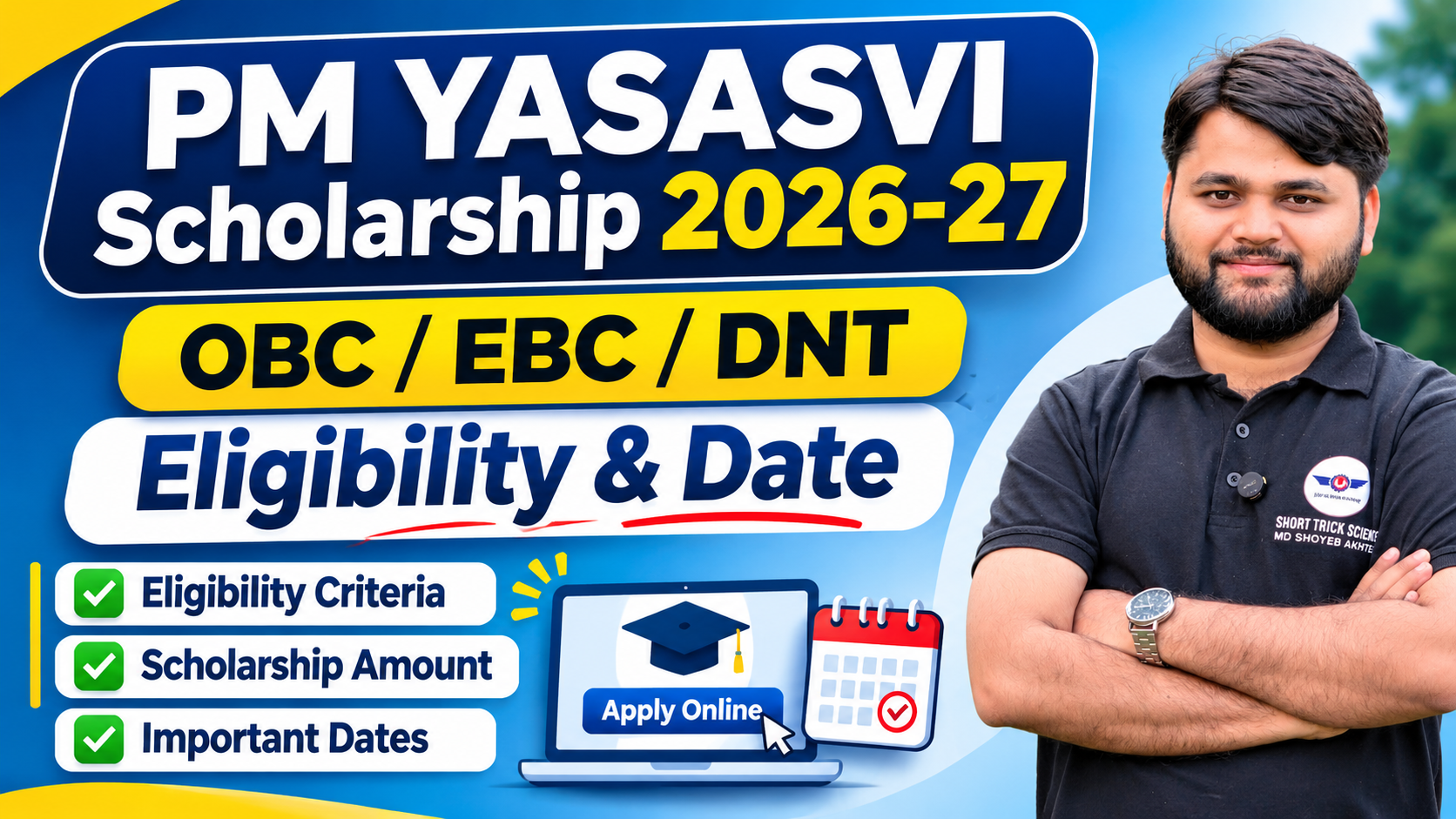
If you belong to the OBC, EBC or DNT category, study in Class 9 to 12, and your family income is up to ₹2.5 lakh a year, you can apply for the PM YASASVI Scholarship 2026-27 on the National Scholarship Portal (NSP). The portal opened on 1 June 2026. The last date is not the same for everyone. It depends on the scheme you are applying under and the state you live in, so the safest move is to check the live deadline on NSP today.
Every year, thousands of eligible students miss out. The reason is rarely that they were ineligible. Usually they trusted an old date from a video, applied under the wrong scheme, or never got their school to verify the form.
This guide is written to prevent exactly that. You will find:
- who is eligible and who is not
- how much money the scheme can give
- why different websites show different last dates, and how to find yours
- a step-by-step application process
- the documents you need, and how to avoid the common mistakes
- what to do after you submit, including verification and payment
Read it once, keep your documents ready, and you can finish the form in a single sitting.
What Is the PM YASASVI Scholarship and Who Is It For?
PM YASASVI is a central government scholarship scheme run by the Ministry of Social Justice and Empowerment. It is meant for students from Other Backward Classes (OBC), Economically Backward Classes (EBC) and Denotified, Nomadic and Semi-Nomadic Tribes (DNT). The idea is simple: a family’s income should not decide whether a talented child can continue their education.
Why the scheme matters
Many families in these categories can manage school up to a point. Then fees, books, transport and coaching start to pile up, and the child is pushed to drop out or move to a lower-quality school. PM YASASVI is designed to ease that pressure by putting money directly into the student’s bank account.
The scheme has more than one part
This is the point most articles skip, and it is the reason for the date confusion online. PM YASASVI is not one single form. It covers several components:
- Pre-matric support for students in Classes 9 and 10
- Post-matric support for students in Classes 11 and 12
- Top Class Education in College, a separate component for higher studies after Class 12
Each component has its own eligibility rules, and sometimes its own timeline. When you read “PM YASASVI last date” on one website and a different date on another, they are often talking about different components.
Who runs what
The scheme is central, but states also have a role. State social welfare departments publish their own notices, set state-level schedules, and handle part of the verification. That is why a student in one state may have a different deadline from a student in another.
PM YASASVI 2026-27 at a Glance
| Detail | What to Know |
|---|---|
| Who can apply | OBC, EBC and DNT students |
| Family income limit | Up to ₹2.5 lakh per year |
| Classes covered | 9 to 12 for school components; a separate college-level scheme exists |
| Maximum benefit (school) | Up to ₹75,000/year (Classes 9-10); up to ₹1.25 lakh/year (Classes 11-12) |
| Application mode | Online only, on scholarships.gov.in |
| Portal opened | 1 June 2026 |
| Last date | Varies by scheme and state; confirm on NSP |
| Verification | By the school/institute, then by nodal officers |
| Payment | Direct Benefit Transfer to an Aadhaar-linked bank account |
| Application fee | None |
PM YASASVI Scholarship Eligibility 2026-27
Before you spend time on the form, check these conditions one by one.
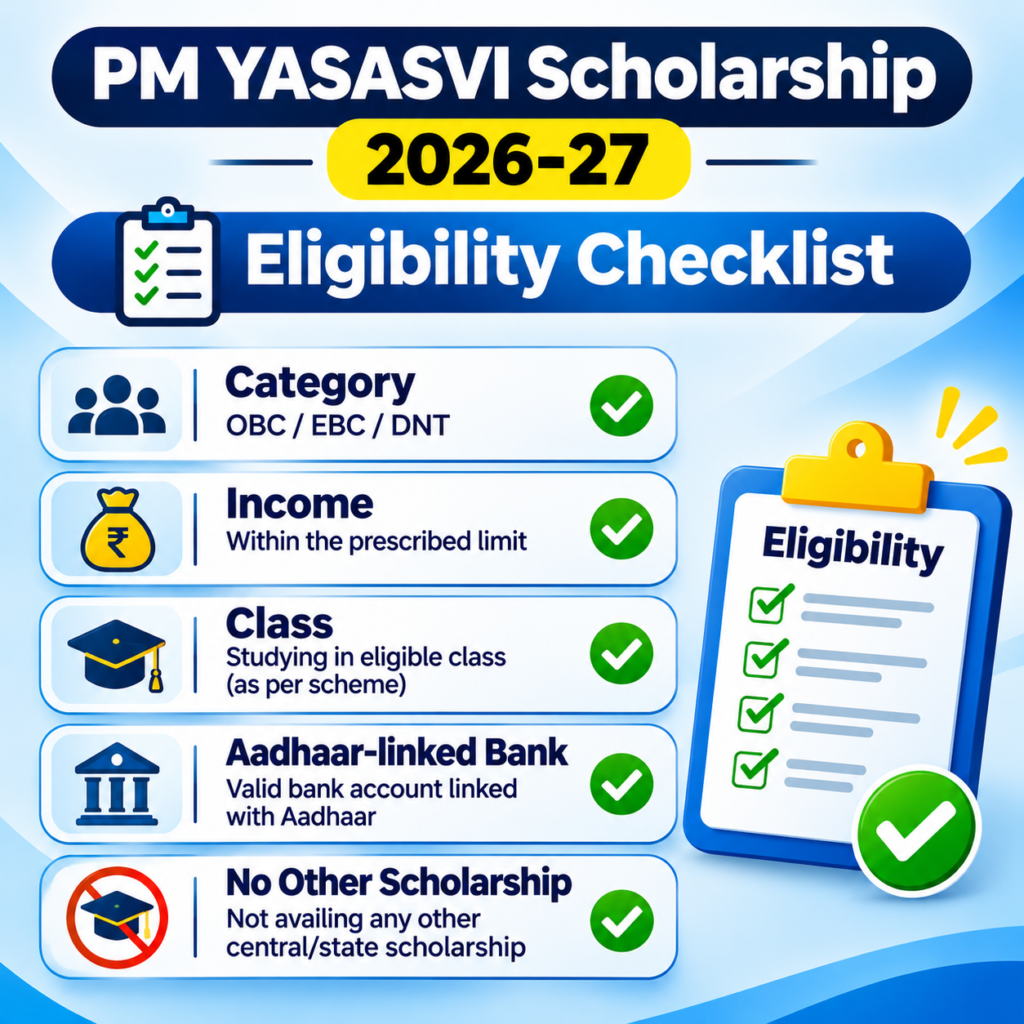
1. Category
You must belong to the OBC, EBC or DNT category and hold a valid certificate to prove it. The certificate must be issued by the competent authority in your state. A certificate that is unclear, expired, or in the wrong format is one of the most common reasons for an application being marked defective.
2. Family income
Your family’s total annual income should be ₹2.5 lakh or less. This is the combined income of the family, not just one parent. You will need an income certificate from the authority your state accepts. Some state-run schemes use a different limit, so if you are applying to a state scheme as well, read its rules separately.
3. Class and institution
The scheme you choose must match your current class. A Class 10 student cannot apply under a Class 11 scheme, and a college student cannot use the school-level form. Also check the type of school the scheme covers. Some listings mention government schools or schools on an approved list, so ask your school whether it qualifies.
4. Bank account
You need a bank account in your own name, linked to your Aadhaar. The money goes straight into this account through Direct Benefit Transfer. If the account is not Aadhaar-seeded, or if DBT is not enabled, the payment can get stuck even after your application is approved.
5. No overlapping scholarship
In general, you should not be receiving another scholarship for the same purpose at the same time. If you have applied somewhere else, read the scheme guidelines before you submit here.
How selection works
For the school-level scheme, selection is merit-based, using marks from your previous qualifying exam. Some online sources say the separate YASASVI entrance test was not held for this cycle. Treat that as something to verify with your school or on NSP, because exam-related details can change between cycles.
PM YASASVI Scholarship 2026-27 is open to OBC, EBC and DNT students in Classes 9 to 12 whose family income is up to ₹2.5 lakh a year. Students apply on the National Scholarship Portal, and deadlines differ by scheme and state, so confirm yours there.
PM YASASVI Last Date: Why You See Different Dates Online
If you have searched for the last date, you have probably seen three or four different answers. Here is how to read them.
What the sources show
Different pages report different deadlines for 2026-27:
- Some listings show 31 August 2026 for the central school-level window.
- Others show 31 October 2026 for pre-matric and for the college-level Top Class scheme.
- Some states have extended or scheduled their own windows into late November.
None of these is necessarily wrong. They describe different components and different states.
Why old dates are a trap
Searches like “pm yashasvi scholarship 2024 last date” bring up results from a past cycle. A date from a previous year has no bearing on 2026-27. If a page does not clearly say which academic year it is talking about, do not rely on it.
How to find your own deadline
- Log in to NSP and open the scheme you plan to apply for. The deadline shown there is the one that counts.
- Check your state’s social welfare or backward classes department notice for state-specific dates.
- Ask your school’s nodal officer, who deals with these timelines every year.
Do not stop at the student deadline
The student deadline is only the first date. After you submit, there is usually a window for the school or institute to verify your form, and a later window for district or state nodal officers. If your school is slow, your application can still fail even though you submitted it on time. That is why you should hand in your printout early and follow up.
A practical rule
Aim to finish at least a week before the earliest date you have seen. The portal gets slow near deadlines, and a form left as a draft is treated as not submitted.
Step-by-Step Application Process
| Step | What to Do | Tip |
|---|---|---|
| 1 | Open scholarships.gov.in and select “New Registration” | Use the student’s own mobile number |
| 2 | Complete One-Time Registration (OTR) and note your ID | Save the ID somewhere safe |
| 3 | Log in and choose “Fresh” or “Renewal” | Renewal is for last year’s recipients |
| 4 | Select PM YASASVI under OBC/EBC/DNT schemes | Pick the correct class-level scheme |
| 5 | Fill in personal, family, bank and school details | Match every detail to your documents |
| 6 | Upload scanned documents | Keep files clear and within the size limit |
| 7 | Preview, then “Final Submit” | A draft is not a submitted application |
| 8 | Take a printout and give it to your school if required | School verification is mandatory |
| 9 | Track status on NSP | Check regularly for “defective” remarks |
Amount, Documents, Fresh vs Renewal
How much money can you get?
For the school-level scheme, support goes up to ₹75,000 a year for Classes 9 and 10 and up to ₹1.25 lakh a year for Classes 11 and 12. These are upper limits. What you actually receive depends on your school’s fees and the allowance structure, so do not plan your budget around the maximum before your application is approved.
Documents to keep ready
Keep clear scans of all of these before you begin:
- Caste certificate (OBC/EBC/DNT)
- Income certificate
- Aadhaar card
- Bank passbook first page or cancelled cheque, in the student’s name
- Previous class marksheet
- School bonafide certificate or admission proof
- Domicile certificate
- Recent passport-size photograph
Tips for clean uploads
- Scan in good light and keep the full page visible.
- Make sure names and dates match across all documents.
- Do not upload photos of a photo. Use a flat scan or a clear phone scan.
- Keep file sizes within the portal’s limit.
Fresh or Renewal?
If you received the scholarship in 2025-26, apply under Renewal. If you are applying for the first time, choose Fresh. Choosing the wrong one can create a duplicate record and cause problems later. Renewal windows in some states have been shorter than fresh windows, so do not leave renewal for the last week.
Where to read about other options
If you are also exploring other funding, you can read about the Azim Premji Scholarship 2026-27: ₹30,000 eligibility and apply process and compare it with what PM YASASVI offers.
Common Problems and How to Fix Them
Most rejections come from small errors, not from students being ineligible. Here is what goes wrong most often, and how to avoid it.
Bank and Aadhaar issues
If the bank account is not linked to Aadhaar, or if the name on the account does not match the application, payment can fail even after approval. Visit your bank early, ask them to seed Aadhaar, and confirm that DBT is enabled on the account.
Defective applications
When a document is blurry, expired, or wrong, your application may be marked “defective”. You then get a limited window to correct it. Check your status on NSP every few days after you submit, because missing that window usually means rejection.
Wrong scheme or category
It is easy to pick the wrong class-level scheme, especially when the portal lists several similar names. Read the scheme name and eligibility line before you select it.
School verification delays
Your school or institute must verify your application. If the nodal officer does not act, your form stays stuck. Give your printout on time, and politely follow up in person.
Income certificate problems
An old certificate, a wrong format, or one from the wrong authority can be rejected. Get a fresh certificate in the format your state accepts.
What to do after submitting
Do not assume you are done. Keep your application ID, your printout, and screenshots of the final submission. Check the status on NSP regularly, respond quickly to any defective remark, and keep your bank details unchanged until payment arrives.
Problem vs Solution
| Problem | Likely Cause | Solution |
|---|---|---|
| Application rejected for bank details | Account not Aadhaar-seeded or name mismatch | Link Aadhaar with the bank and make sure the name matches exactly |
| “Defective” status | A document is blurred or wrong | Re-upload clear scans within the correction window |
| Cannot find the right scheme | Wrong class or category selected | Recheck your class and OBC/EBC/DNT category before choosing |
| Missed the date | Confused scheme and state deadlines | Check your scheme’s deadline on NSP and your state notice |
| School has not verified | Printout not submitted or officer delayed | Contact the school’s nodal officer straight away |
| Income certificate rejected | Old or wrong format | Get a fresh certificate in the format your state accepts |
| Duplicate application error | Applied “Fresh” after already receiving the scholarship | Use “Renewal” and contact the NSP helpdesk if needed |
| Payment not received | DBT not enabled on the account | Ask your bank to enable DBT and check status on NSP |
| Cannot log in | Forgotten OTR ID or password | Use the portal’s recovery option or contact the helpdesk |
the National Scholarship Portal
If you are also looking for other support, you can read about the Azim Premji Scholarship 2026-27: ₹30,000 eligibility and apply process before the dates pass.
Azim Premji Scholarship 2026-27: ₹30,000 eligibility and apply
FAQ
What is the last date for PM YASASVI Scholarship 2026-27?
It depends on the scheme and the state. Reported dates range from 31 August 2026 for some school-level windows to 31 October 2026 for pre-matric and college-level applications, and some states run into late November. Check the live deadline on NSP.
Who is eligible for the PM YASASVI scholarship?
OBC, EBC and DNT students with a family income of up to ₹2.5 lakh a year, studying in a class covered by the scheme. You also need an Aadhaar-linked bank account and a valid caste certificate.
What is the income limit for PM YASASVI?
The family income limit is ₹2.5 lakh per year. Some state-run schemes use different limits, so read your state’s guidelines as well.
How much money does PM YASASVI give?
School-level support goes up to ₹75,000 a year for Classes 9-10 and up to ₹1.25 lakh a year for Classes 11-12. The actual amount depends on the school’s fees and allowances.
Is there an entrance exam for PM YASASVI 2026-27?
Some sources say the separate YASASVI entrance test was not held this cycle and that selection follows earlier marks. Confirm this with your school or on NSP before relying on it.
Is the PM YASASVI form free?
Yes. There is no fee to apply on NSP. Be careful of any website, agent or cyber café asking you to pay for the scholarship itself.
Can I apply again if I got the scholarship last year?
Yes, through the “Renewal” option. Do not choose “Fresh”, as that can create a duplicate application.
Why was my PM YASASVI application rejected?
The usual reasons are an unlinked or mismatched bank account, unclear documents, wrong category or class selection, or school verification not being completed.
Conclusion
PM YASASVI can make a real difference for an OBC, EBC or DNT family, but only if the application is complete, verified and submitted on time. The scheme is not hard to apply for. What trips people up is the small stuff: the wrong date, a blurred document, a bank account that is not linked, or a school form that never got verified.
The most useful thing you can do today is confirm your own scheme’s deadline on NSP, gather your documents, and make sure your school knows to verify your form. If you are unsure about any step, ask your school’s nodal officer or the NSP helpdesk rather than guessing. A short conversation now is far better than a rejected form later.
Take it one step at a time, finish early, and keep your records safe. Good luck with your application.