ONGC Scholarship 2026-27: ₹48,000 Per Year, Eligibility & Apply Online
Introduction
The ONGC Scholarship 2026-27 gives selected students ₹48,000 every year, which works out to ₹4,000 a month, until their course is over. The online application is open from 18 October to 30 November 2026 on ongcscholar.org. Before you can apply there, you need a National Scholarship Portal (NSP) One-Time Registration number. After the online form, you also have to post a printed copy with attested documents.
If you have been searching for “ONGC scholarship apply online” or “how to apply ONGC scholarship 2026-27”, this guide gives you the whole picture in one place. It covers who can apply, which courses count, how the 2,000 seats are divided, the documents you need, and a step-by-step application process. It also explains how selection works, how and when the money is paid, how renewal works, and the mistakes that most often cost students their seat.
Read it once fully, and then keep the tables open while you fill in the form.
What Is the ONGC Scholarship 2026-27 and Who Is It For?
The ONGC scholarship is run by the ONGC Foundation, the social responsibility arm of Oil and Natural Gas Corporation Limited. Its official name is a mouthful: the ONGC Scholarship to Meritorious SC/ST, OBC and General Category Students. Most students simply call it the ONGC Merit Scholarship.
Each year the Foundation funds 2,000 scholarships. Every selected student receives ₹48,000 a year. If you were wondering whether “ONGC scholarship 48000 per year” is accurate, it is, and the amount continues until you finish your course, as long as you keep meeting the renewal conditions.
A few things make this scheme different from many other scholarships:
- It is for first-year students only. You must have just been admitted to the first year of a full-time regular course. Second- and third-year students cannot apply.
- Only four course types qualify. These are Engineering, MBBS, MBA, and Master’s in Geology or Geophysics.
- Girls get half the seats. In every category, 50% of scholarships are reserved for girl students.
- There is no exam. No written test and no interview. Your qualifying marks and your family’s financial situation decide everything.
- It is a one-time benefit. You can receive the ONGC scholarship once in your life, for one course.
That is why the first question you should ask yourself is not “Can I apply?” but “Am I in the right year, the right course and the right income bracket?”
The ONGC Scholarship 2026-27 pays ₹48,000 per year (₹4,000 per month) to 2,000 first-year students of Engineering, MBBS, MBA and Geology/Geophysics. Applicants need 60% marks, age up to 30, and family income below the category limit. Applications run from 18 October to 30 November 2026 at ongcscholar.org. (47 words)
Quick Summary
| Detail | Information |
|---|---|
| Scheme name | ONGC Scholarship to Meritorious SC/ST, OBC and General Category Students 2026-27 |
| Provider | ONGC Foundation (ONGC Ltd.) |
| Total scholarships | 2,000 |
| Amount | ₹48,000 per year (₹4,000 per month) |
| Duration | Until the course is completed |
| Eligible courses | Engineering (4 yrs), MBBS (4 yrs), MBA (2 yrs), Master’s in Geology/Geophysics (2 yrs) |
| Seat split by category | SC/ST 1,000 · OBC 500 · General-EWS 500 |
| Girls’ reservation | 50% in every category |
| Selection method | Merit (qualifying marks) with preference for BPL families |
| Application window | 18 October – 30 November 2026 |
| Payment mode | ECS to bank account, once a year |
| Mandatory first step | NSP One-Time Registration (OTR) |
| Official portal | ongcscholar.org |
Which Courses and How Many Seats? (Course-wise and Category-wise)
Students often ask how tough the competition is. The seat numbers help you judge. Engineering has by far the largest share, followed by Geology/Geophysics and MBA.
| Course | SC/ST | OBC | General-EWS | Total |
|---|---|---|---|---|
| Engineering | 500 | 300 | 300 | 1,100 |
| MBBS | 90 | 50 | 50 | 190 |
| MBA | 140 | 50 | 50 | 240 |
| Master’s in Geology / Geophysics | 270 | 100 | 100 | 470 |
| Total | 1,000 | 500 | 500 | 2,000 |
Your course also has to be recognised by AICTE, MCI, UGC, AIU, or the Central or State Government. A course from an unrecognised institute will not qualify, however good your marks are.
What this means for you: If you are an SC/ST student in Engineering, you are competing for 500 seats. If you are an OBC or General-EWS MBBS student, only 50 seats exist in your category nationwide, and they are split across five zones. Plan to submit a clean, complete application, because small gaps matter more when the seat count is low.
ONGC Scholarship 2026-27 Eligibility Criteria
Go through every point below before you start filling the form.
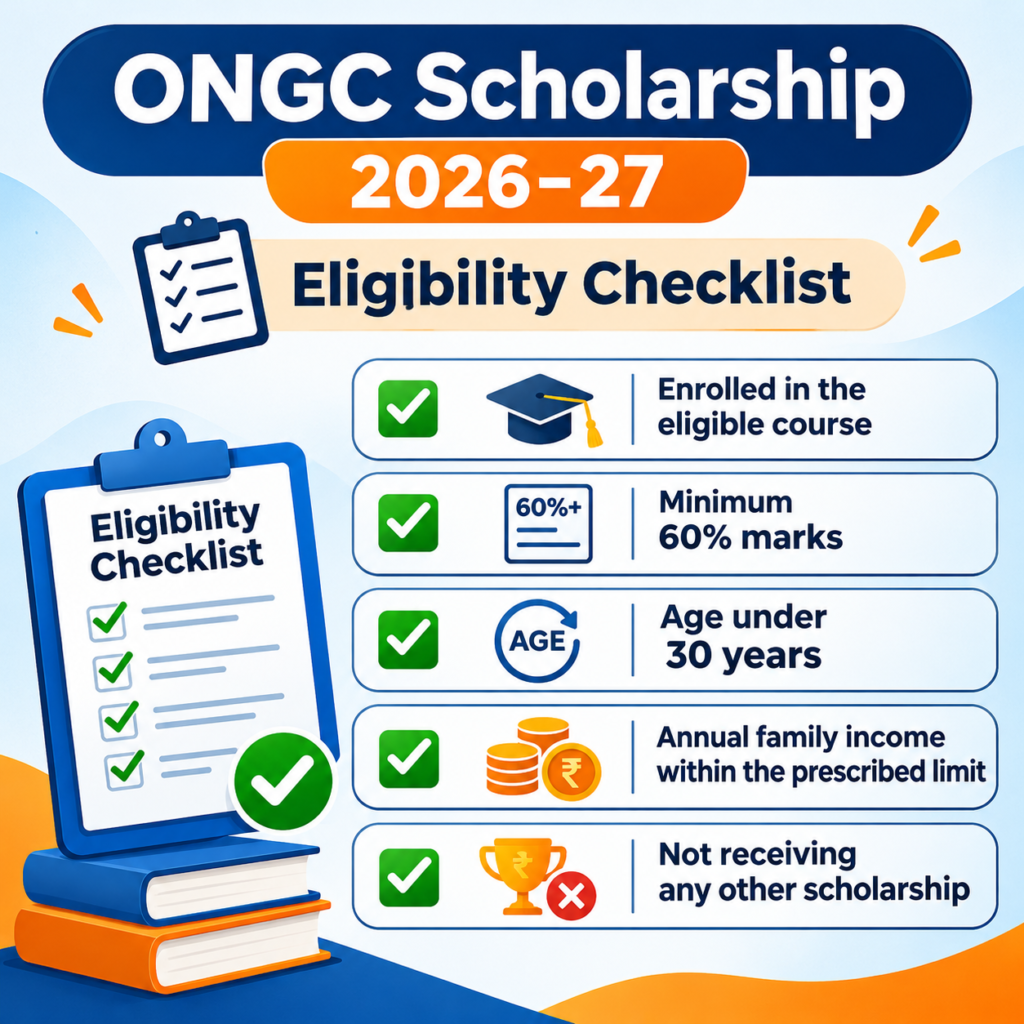
Basic conditions for all categories
- You must be an Indian citizen.
- You must be a first-year student in one of the four eligible full-time courses.
- You must apply only under your own category scheme (SC/ST, OBC or General-EWS).
- You must not be receiving any other scholarship or financial assistance.
- You can get the ONGC scholarship only once in a lifetime and for one course.
Marks required
- Engineering and MBBS applicants need at least 60% in Class 12.
- MBA, Geology and Geophysics applicants need at least 60% in graduation.
- If your university uses CGPA, the minimum is 6.0 on a 10-point scale.
Age limit
- The maximum age is 30 years as on 1 August 2026. This is the same for SC/ST, OBC and General-EWS applicants.
Family income limit
| Category | Gross annual family income |
|---|---|
| SC/ST | Less than ₹4.5 lakh |
| OBC | Less than ₹2 lakh |
| General-EWS | Less than ₹2 lakh |
The income figure on your certificate is what counts, so get it issued from the competent authority and check it carefully against the limit before you apply.
A common doubt is whether students who have already got a state or central scholarship can still apply. The answer is no. The “no other scholarship” rule is strict, so if you are already receiving one, you cannot take this one.
OBC students who want to compare other central options can read our guide to the PM YASASVI Scholarship 2026-27 eligibility and last date before deciding which scheme suits them. (Internal link goes here.)
Zone-wise Distribution of Scholarships
ONGC does not pick winners from one national list. Seats are spread equally across five zones, and your zone depends on the location of the school or college where you passed Class 12 or graduation, not where you live now.
| Zone | States / UTs | SC/ST | OBC | General-EWS |
|---|---|---|---|---|
| Zone 1 (North) | J&K, Delhi, Punjab, Himachal Pradesh, Haryana, Chandigarh, Uttarakhand, Uttar Pradesh | 200 | 100 | 100 |
| Zone 2 (West) | Maharashtra, Gujarat, Rajasthan, Madhya Pradesh, Goa, Daman & Diu, Dadra & Nagar Haveli | 200 | 100 | 100 |
| Zone 3 (North East) | Assam, Sikkim, Mizoram, Arunachal Pradesh, Nagaland, Manipur, Meghalaya, Tripura | 200 | 100 | 100 |
| Zone 4 (East) | Bihar, Jharkhand, Odisha, Chhattisgarh, West Bengal | 200 | 100 | 100 |
| Zone 5 (South) | Tamil Nadu, Kerala, Karnataka, Andhra Pradesh, Telangana, Puducherry, Lakshadweep, Andaman & Nicobar Islands | 200 | 100 | 100 |
If one zone gets too few eligible applicants, the unused seats can be redistributed to other zones. In practice this means that a strong application is never wasted just because your zone is busy, but you should not count on it either.
Every zone has 400 seats in total. A student from Lucknow or anywhere else in Uttar Pradesh falls in Zone 1, and a student from Patna or Kolkata falls in Zone 4.
Documents Required for ONGC Scholarship Online Apply
Collect your papers before you open the portal. Hunting for a certificate halfway through the form is how deadlines get missed. All certificates have to be certified and attested by the head, principal or dean of your institute.
| Document | Who needs it | Notes |
|---|---|---|
| Caste certificate | SC/ST/OBC applicants | Hindi or English |
| Age proof | All | Birth certificate or Class 10 marksheet |
| Class 12 marksheet | Engineering, MBBS | Must show the 60% / 6.0 CGPA |
| Consolidated graduation marksheet | MBA, Geology, Geophysics | All-semester, consolidated |
| Family income certificate | All | Hindi or English, within the category limit |
| Bank details on ECS form | All | Attested by the bank |
| PAN card copy | All | Name must match |
| College / institute ID card | All | Current year |
| Admission receipt | All | Proof of first-year admission |
| Undertaking | All | In the prescribed format |
Small habits that save applications:
- Keep scanned copies in PDF or image form, clear and readable, so uploads don’t get rejected.
- Make sure your name is spelled the same way on every document.
- Check that the bank account is active and in your own name, since the payment goes there.
- Keep a second set of photocopies for yourself, in case the postal packet is delayed.
How to Apply for ONGC Scholarship 2026-27 (Step by Step)
The ONGC scholarship online apply process has two parts: the online form and the hard-copy submission. Many students do the first and forget the second, so treat them as one job. Visit the official ONGC scholarship portal only for registration and application, and avoid third-party sites that ask for money.
Step-by-Step Application Process
| Step | What to do | Tip |
|---|---|---|
| 1 | Create your One-Time Registration (OTR) on scholarships.gov.in | Do this first; the ONGC form needs the OTR number |
| 2 | Open ongcscholar.org and click “First Time Registrant” | Use your own phone number and email |
| 3 | Fill in name, date of birth, mobile and email exactly as in your NSP profile | Spelling must match |
| 4 | Save the passkey sent to your email or mobile | You need it to log in again |
| 5 | Log in, open the “Apply Scholarship” tab and enter your NSP OTR number | Re-check every digit |
| 6 | Fill in personal, academic and bank details carefully | Verify the account number and IFSC code |
| 7 | Upload all attested documents | Keep files clear and complete |
| 8 | Print the application form and send it with attested documents to the ONGC office address shown on the form | Use a trackable post service and keep the receipt |
| 9 | Finish both online and postal steps before 30 November 2026 | Aim to finish a week early |
How Selection Works and What Counts
ONGC does not hold an entrance test or interview. The Foundation follows a simple merit and need-based order:
- Merit is decided from your aggregate marks in the qualifying exam, which is Class 12 or graduation depending on your course.
- Below Poverty Line (BPL) families get first preference.
- If there are not enough BPL applicants, other eligible students are considered.
- If two candidates have the same marks, the one with lower family income is ranked higher.
- The Foundation’s decision is final.
This is why your qualifying marks matter more than anything else you can control now. If your score is borderline, your income certificate and complete documents become the deciding factors.
Scholarship Amount, Payment and Yearly Renewal
Selected students receive ₹4,000 per month, which is ₹48,000 per year. The money is paid once a year by ECS directly into your bank account, after the academic year ends. So you should not expect monthly credits, and it helps to plan your fees with that in mind.
To keep the scholarship going:
- You must be promoted to the next academic year.
- You must maintain at least 60% marks or 6.0 CGPA.
- You must apply online for renewal every year.
For a 4-year Engineering or MBBS course, that is up to ₹1,92,000 over the full course. For a 2-year MBA or Master’s course, it is up to ₹96,000. The scholarship is meant to help with fees, books and living costs, but it will not cover everything on its own.
| Course | Duration | Maximum total support |
|---|---|---|
| Engineering | 4 years | ₹1,92,000 |
| MBBS | 4 years | ₹1,92,000 |
| MBA | 2 years | ₹96,000 |
| Master’s in Geology / Geophysics | 2 years | ₹96,000 |
(Totals assume the scholarship continues each year with renewal. They are calculated from the yearly amount, so check the official notice for any change.)
Common Mistakes That Can Cost You the Scholarship
Most rejections have nothing to do with marks. They come from small slips:
- Skipping the hard copy. Finishing the online form and never posting the printout is the biggest mistake.
- Mismatched details. A different date of birth or spelling between NSP, the ONGC form and your marksheet causes trouble.
- Unattested documents. Copies without the head’s or dean’s attestation can be treated as invalid.
- Wrong category. Apply only under the scheme your certificate supports.
- Wrong income certificate. An old certificate, or one that shows income above the limit, will block your application.
- Waiting for the last day. The portal and post offices are both busiest in the final week.
- Trusting old dates. Some websites still show 15 May 2026, which belonged to the previous cycle.
Problem vs Solution
| Problem | Solution |
|---|---|
| Don’t have an OTR number | Create it first at scholarships.gov.in, then register on ONGC |
| Details differ between NSP and ONGC | Re-enter exactly as in NSP, matching your marksheet |
| Lost the passkey | Check your registered email and SMS; don’t register again |
| Documents rejected | Get attestation from the head or dean, then upload clear scans |
| Unsure about your zone | Use the state where you passed Class 12 or graduation |
| Forgot to post the hard copy | Send it immediately by trackable post before 30 November |
| Bank account not matching | Use an active account in your own name; get the ECS form attested |
| Seeing “15 May 2026” on some sites | That was the earlier cycle; check the official announcements page |
| Income above the limit | You are not eligible under that category; check other schemes |
the official ONGC scholarship portal
OBC, EBC and DNT students who also want to explore central schemes can read our guide to the PM YASASVI Scholarship 2026-27: OBC/EBC/DNT eligibility and date before choosing.
Smart Tips to Improve Your Chances
You can’t change your marks now, but you can make sure nothing else holds your application back.
- Start with the OTR today. It’s the one step everything else depends on.
- Get the income certificate early. Offices can be slow, and a late certificate is the most common reason students miss out.
- Do a final cross-check. Compare your name, date of birth and category across every document before you submit.
- Post the packet early. Send it at least a week before the date, and keep the postal receipt.
- Save everything. Keep your passkey, acknowledgement number, form printout and upload copies in one folder.
- Track your application. Use your acknowledgement number on the portal to check status.
- Check announcements regularly. Dates, rules or addresses can be updated on the official page.
FAQ
What is the last date for ONGC Scholarship 2026-27?
The last date is 30 November 2026. Applications opened on 18 October 2026.
How can I apply for the ONGC scholarship online?
Create your NSP OTR number, register on ongcscholar.org, fill in the form, upload attested documents, and post the printed copy to the ONGC office mentioned on the form.
Is the ONGC scholarship really ₹48,000 per year?
Yes. It is ₹4,000 per month, paid once a year into your bank account until the course ends.
Is NSP registration compulsory for ONGC scholarship?
Yes. You need your OTR number to complete the ONGC application.
What is the income limit for the ONGC scholarship?
Below ₹4.5 lakh a year for SC/ST candidates, and below ₹2 lakh for OBC and General-EWS candidates.
Can BA, BSc or BCom students apply?
No. The scheme covers only Engineering, MBBS, MBA, and Master’s in Geology or Geophysics.
Is there an exam or interview?
No. Selection depends on your qualifying marks and financial background, with BPL families getting first preference.
Conclusion
The ONGC Scholarship is one of the more generous corporate schemes for students in professional courses, but it rewards the students who prepare early. The steps are simple: create your OTR number, gather and attest your documents, fill in the online form carefully, and post the hard copy well before 30 November.
Don’t leave the work to the final evening. Portals slow down, offices close early, and one missing stamp can undo weeks of effort. Check the latest notice on the official portal once more before you submit, since details can change.
If you qualify, the effort is small compared with ₹48,000 a year for the length of your course. Take it one step at a time, and apply with confidence.