
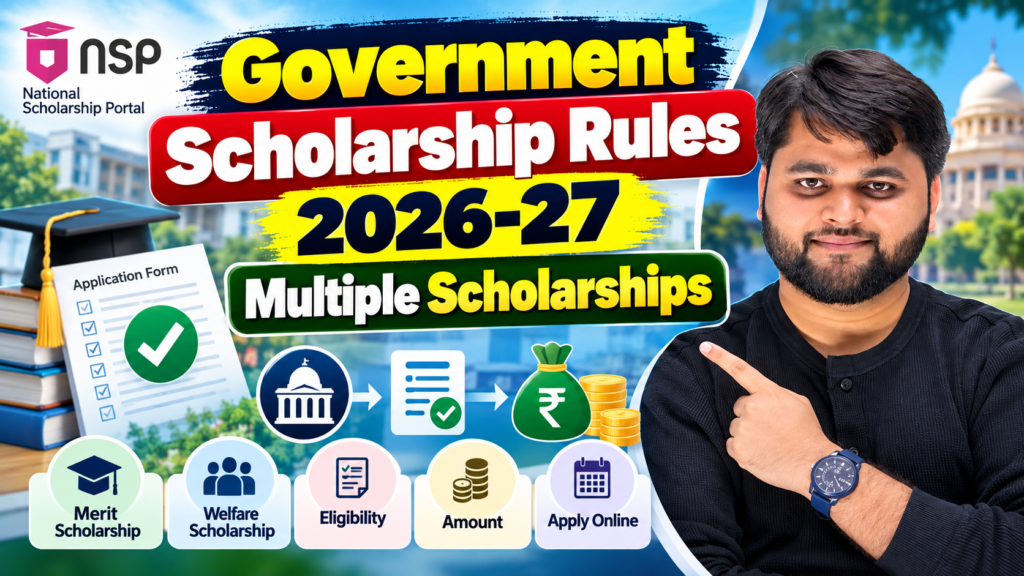
Government Scholarship Rules 2026-27 Revised: One Student, Multiple Scholarships Explained
Introduction
The Government Scholarship Rules 2026-27 Revised: One Student, Multiple Scholarships Explained update brings an important change for students applying through the National Scholarship Portal (NSP). From the 2026-27 academic year, the official NSP says students may apply for one merit-based scholarship scheme and one or more welfare-based scholarship schemes, provided they meet the eligibility requirements of each scheme.
This does not mean that every student can receive unlimited scholarships. The type of scholarship, eligibility conditions, scheme guidelines and verification requirements still matter.
In this article, we explain the one student multiple scholarship rule, how many scholarships one student can apply for, the difference between merit and welfare scholarships, and what students should check before applying.
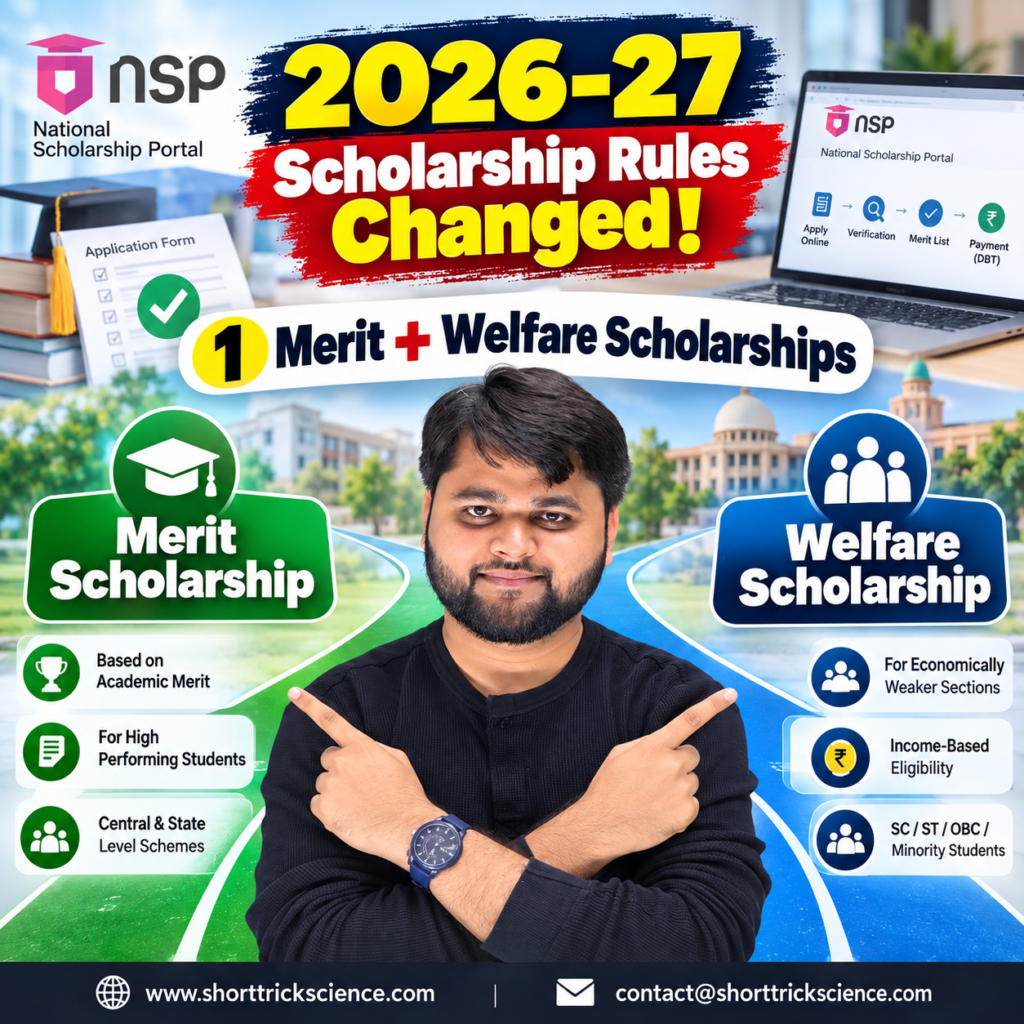
What Are the New Government Scholarship Rules for 2026-27?
The biggest change is that the NSP framework for 2026-27 allows an eligible student to apply for one merit-based scholarship and one or more welfare-based scholarships. The official NSP itself displays this rule for the 2026-27 academic year.
Earlier, students often understood the scholarship system as “One Student – One Scholarship.” The revised framework separates scholarships into different categories so that a merit-based benefit and welfare-based support are not automatically treated as duplicate benefits.
However, students should not assume that simply applying for several schemes guarantees several payments.
Each scholarship has its own:
- Eligibility requirements
- Income limit
- Academic requirements
- Category requirements
- Course or institute conditions
- Document requirements
- Verification process
Therefore, students should always check the specific scheme guidelines before submitting an application.
Featured Snippet Answer
A student can apply for one merit-based scholarship and one or more welfare-based scholarships under the NSP 2026-27 framework, provided the student meets the individual eligibility conditions of each scheme. This does not mean unlimited scholarships or automatic approval of every application.
Quick Summary
| Question | 2026-27 Rule |
|---|---|
| Can one student apply for multiple scholarships? | Yes, subject to scheme rules |
| Merit-based scholarships | One merit-based scheme |
| Welfare-based scholarships | One or more may be allowed |
| Can every scholarship be combined? | No |
| Is eligibility still required? | Yes |
| Is OTR required on NSP? | Yes |
| Does multiple application mean multiple payments? | Not automatically |
| Academic year | 2026-27 |
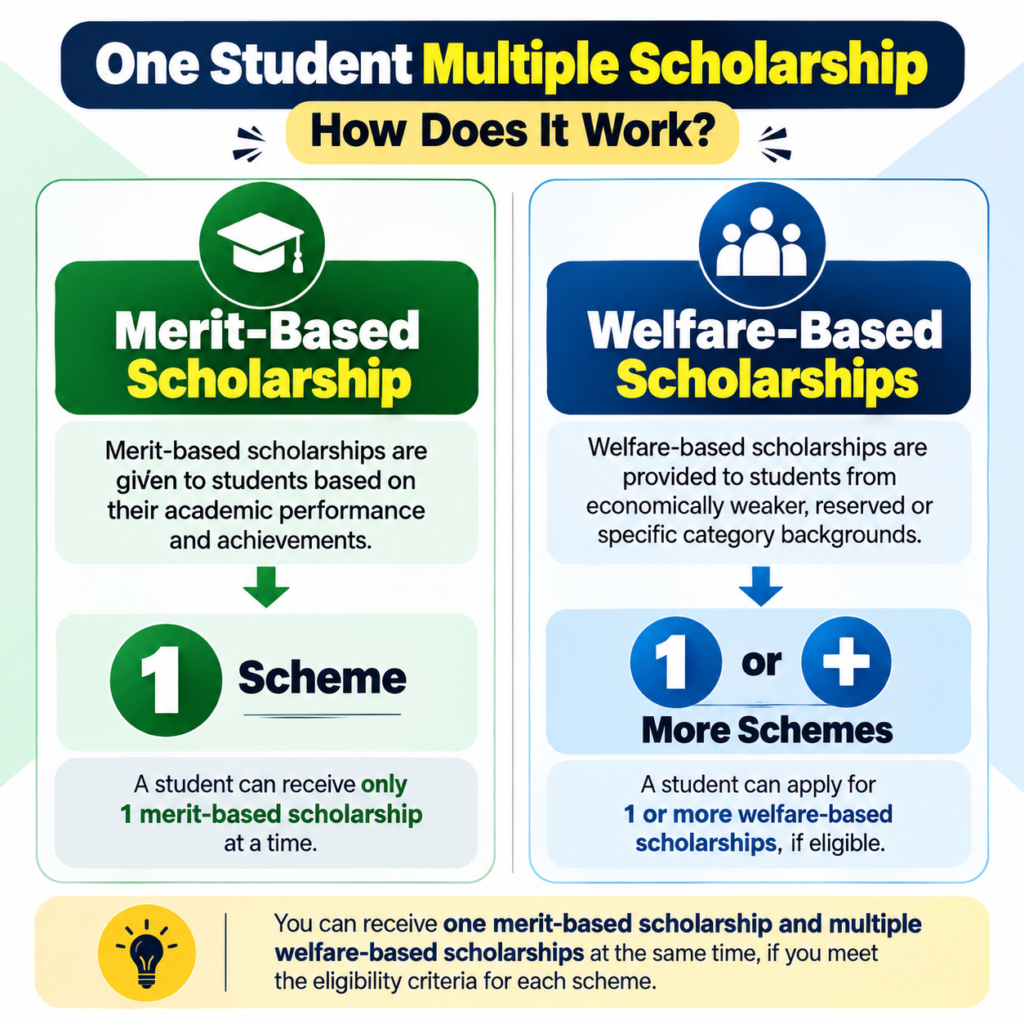
One Student Multiple Scholarship: How Does It Work?
The easiest way to understand the revised rule is to separate scholarships into merit-based and welfare-based categories.
Merit-Based Scholarships
Merit-based scholarships generally focus on academic performance, examination results or other achievement-related criteria.
Examples mentioned in the revised framework include schemes such as:
- National Means-cum-Merit Scholarship Scheme (NMMSS)
- Central Sector Scheme of Scholarships for College and University Students
- INSPIRE-related scholarship support
Welfare-Based Scholarships
Welfare-based scholarships are designed to provide financial support to eligible students based on factors such as social category, economic circumstances or other specified welfare criteria.
Examples can include eligible SC, ST, OBC and minority welfare scholarship schemes, depending on the individual scheme guidelines.
The important point is that the category of the scholarship matters.
A student should not simply look at the number of scholarships available and assume that all of them can be combined.
The official NSP currently states that students may apply for one merit-based scholarship and one or more welfare-based scholarship schemes from AY 2026-27, subject to scheme eligibility.
How Many Scholarships Can One Student Apply For?
There is no simple answer such as “5 scholarships” or “10 scholarships” for every student.
Under the current NSP rule, the key combination is:
1 merit-based scholarship + one or more eligible welfare-based scholarships.
But the exact number depends on which schemes the student qualifies for and what their individual guidelines allow.
How to Apply for Multiple Government Scholarships in 2026-27?
Students should first identify the scholarships they are eligible for instead of submitting applications randomly.
The National Scholarship Portal is open for Academic Year 2026-27, and the official portal states that OTR is mandatory for students applying for scholarships.
Your OTR is a unique registration number that remains associated with the student throughout their academic career.
Step 1: Complete Your OTR
If you are applying through NSP, complete your One-Time Registration first.
Step 2: Check Your Eligible Schemes
Read the eligibility criteria of every scholarship carefully.
Check:
- Class or course
- Academic marks
- Family income
- Category
- Domicile requirements
- Institute requirements
- Other scheme-specific conditions
Step 3: Identify the Scholarship Category
Find out whether the scholarship is classified as merit-based or welfare-based.
This is particularly important when you are already receiving another scholarship.
Step 4: Prepare Your Documents
Keep commonly required documents ready, such as:
- Aadhaar or required identity document
- Bank account details
- Income certificate
- Category certificate, where applicable
- Academic marksheets
- Bonafide/admission proof
- Fee details
- Other scheme-specific documents
Step 5: Submit the Application
Fill in the information carefully and submit the application before the deadline applicable to that scheme.
Step 6: Track Verification
After submission, the application goes through the applicable verification process.
Do not assume that submission means approval.
Step-by-Step Process
| Step | What Students Should Do |
|---|---|
| 1 | Complete NSP OTR |
| 2 | Find scholarships matching your eligibility |
| 3 | Check whether each scheme is merit or welfare based |
| 4 | Read individual eligibility conditions |
| 5 | Prepare required documents |
| 6 | Submit the application correctly |
| 7 | Complete institute/authority verification |
| 8 | Track application and payment status |
Important Things to Check Before Applying for Multiple Scholarships
The revised rule makes the scholarship system more flexible, but students still need to be careful.
For example, being eligible for a welfare scholarship does not automatically make you eligible for every welfare scheme.
Similarly, applying for a merit-based scholarship does not guarantee selection. Academic requirements, income limits, course requirements and other conditions continue to apply.
Another important point is verification.
The revised NSP process is designed to provide greater visibility of a student’s applications across the verification process. This means students should keep information consistent across applications and correct any general or academic details carefully.
Common Problems Students May Face Under the New Scholarship Rules
The revised system does not remove the need for accurate information.
A mistake in academic details, income information, bank details or documents can still create problems during verification.
Students should also remember that scholarship rules can differ between central government scholarships, state government scholarships and other scholarship providers.
Do not assume that a rule applying to an NSP scheme automatically applies to a state scholarship or private scholarship.
Problem vs Solution
| Common Problem | What You Should Do |
|---|---|
| Applying without checking eligibility | Read the complete scheme eligibility first |
| Assuming unlimited scholarships are allowed | Check whether the schemes can be combined |
| Confusing merit and welfare categories | Check the scheme classification |
| Incorrect income details | Use valid and updated documents |
| Wrong bank information | Verify bank and Aadhaar/DBT-related details |
| Application marked defective | Read the deficiency and correct the required details |
| Multiple applications have inconsistent information | Keep general and academic details accurate |
| Payment is delayed | Track verification and payment status |
| Assuming application means approval | Wait for verification and final sanctionv |
government scholarship rules and eligibility details
official National Scholarship Portal
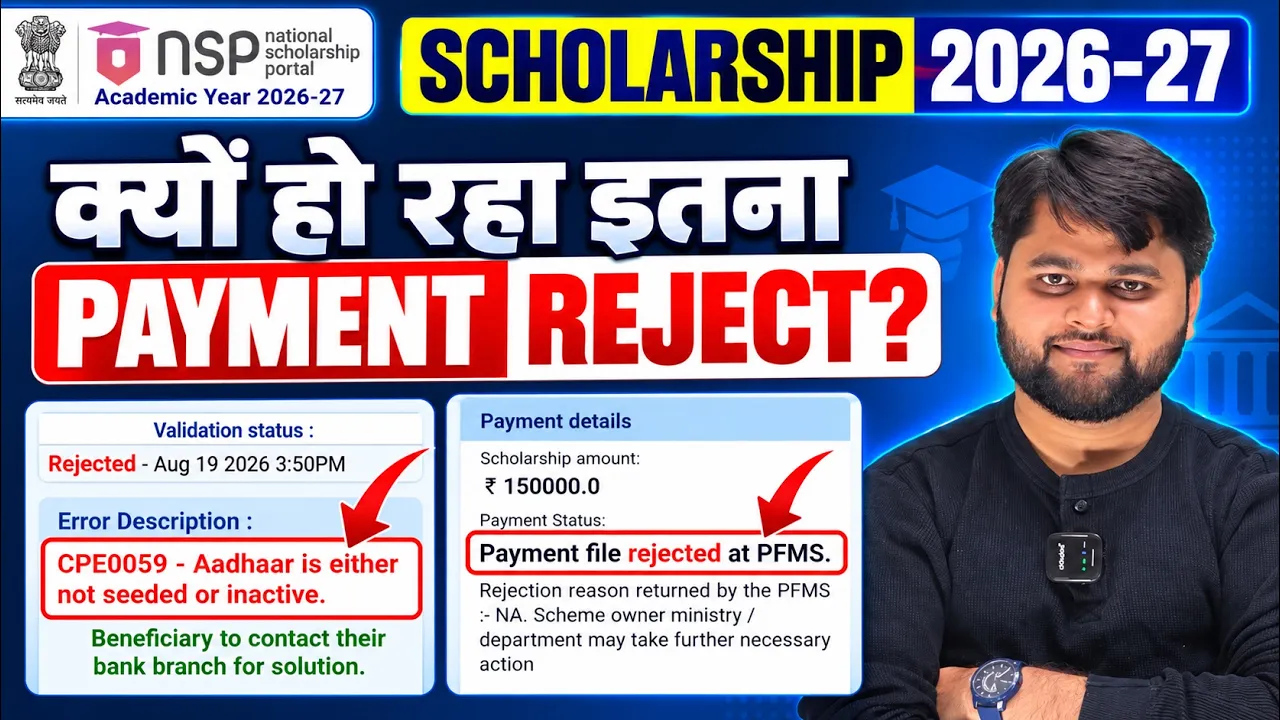
NSP Scholarship Payment File Rejected at PFMS: What to Do
Can One Student Get Multiple Government Scholarships in 2026-27?
Yes. Under the NSP 2026-27 framework, an eligible student may apply for one merit-based scholarship and one or more welfare-based scholarships, subject to the eligibility conditions of each scheme. Students should not assume that every scholarship can be combined or that every application will result in payment.
FAQ
Can one student apply for multiple scholarships in 2026-27?
Yes. Under the current NSP framework, students may apply for one merit-based scholarship and one or more welfare-based scholarships, subject to eligibility.
How many scholarships can one student get?
There is no single fixed number for every student. Under the NSP 2026-27 framework, the permitted combination is one merit-based scheme with one or more eligible welfare-based schemes.
Can I receive two merit-based government scholarships?
The revised NSP rule specifically provides for one merit-based scholarship along with one or more welfare-based scholarships. Therefore, students should not assume that two merit-based schemes can be combined.
Can I get a merit scholarship and a welfare scholarship together?
Yes, the NSP 2026-27 framework allows this combination when the student independently meets the eligibility conditions of both schemes.
Is OTR mandatory for NSP scholarships?
Yes. The official NSP states that One-Time Registration (OTR) is mandatory for students seeking scholarships through the portal.
Does applying for multiple scholarships guarantee multiple payments?
No. Applying and receiving are different stages. Every scheme has its own eligibility and verification requirements.
Can I apply for central and state government scholarships together?
It depends on the individual scholarship rules. The NSP multiple-scholarship provision should not automatically be applied to every state government scholarship.
What happens if two scholarship applications have different information?
Students should keep their general, academic and other important information accurate and consistent. Differences may lead to verification issues or requests for correction.
Conclusion
The Government Scholarship Rules 2026-27 bring an important change for students who were previously confused about applying for more than one scholarship. The current NSP framework allows an eligible student to apply for one merit-based scholarship and one or more welfare-based scholarships, but this is not a blanket permission to combine every scholarship.
The safest approach is simple: check the category of the scholarship, read its individual eligibility conditions, keep your documents accurate and track the application through verification.
If you are applying for scholarships in 2026-27, do not rely only on old “one student, one scholarship” information. Always check the latest NSP information and the specific scheme guidelines before making your application.





One Response