NSP Scholarship 2026-27 Apply Last Date: Check Application Deadline and Latest Updates
Introduction
Students planning to apply for the NSP Scholarship 2026-27 should check their scheme’s application deadline before submitting the form. According to the official National Scholarship Portal, the application cycle for the 2026-27 academic year opened on 1 June 2026. Many schemes currently listed on the portal show 31 October 2026 as the student application deadline, but the final date is not the same for every scholarship.
The NSP Scholarship 2026-27 apply last date depends on the scholarship scheme, eligibility category and application type. Students applying for a fresh scholarship and those renewing an existing scholarship should check the relevant scheme’s official schedule rather than rely on a general deadline mentioned on social media.
For example, the official portal lists 31 October 2026 as the application deadline for renewal applications under the PM-USP Central Sector Scheme of Scholarship for College and University Students (CSSS) and the PM-USP Special Scholarship Scheme for Jammu, Kashmir and Ladakh. Several other listed schemes also show this date. Verification deadlines are later and should not be confused with the student application deadline.
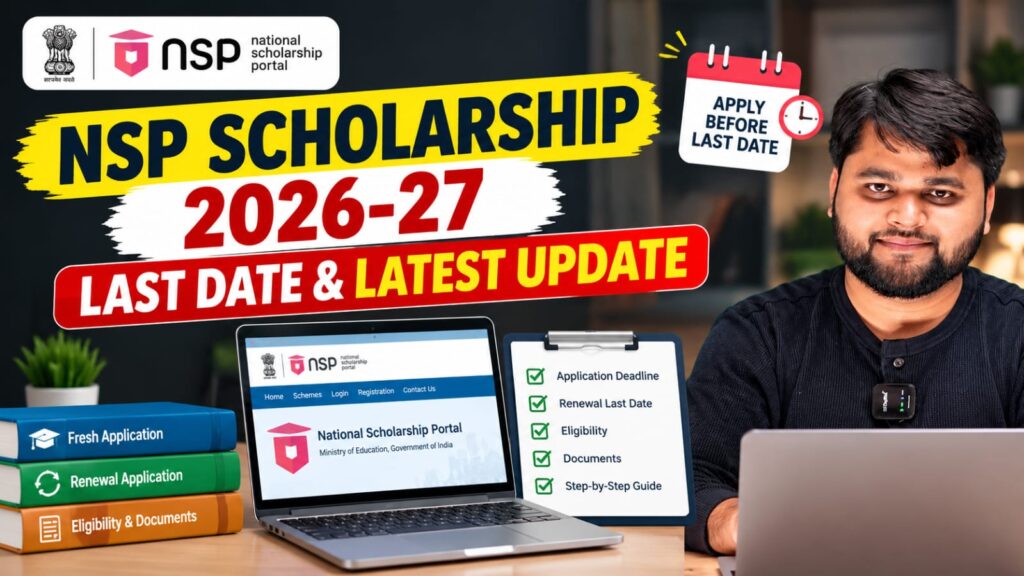
This guide explains the latest verified NSP Scholarship 2026-27 updates, fresh and renewal application deadlines, how to check the official schedule, the online application process, required documents, common application problems and what students should do before submitting their forms.
Important: The dates in this article reflect official information available on 22 October 2026. Always recheck your individual scheme’s listing before applying, because the government may issue a revised schedule.

NSP Scholarship 2026-27 Apply Last Date – Latest Official Update
The most important thing students need to understand is that the National Scholarship Portal hosts multiple scholarship schemes administered by different ministries and departments. Each scheme can have its own application opening date, closing date, eligibility requirements and verification schedule.
As of 22 October 2026, the official NSP website displays the following general updates:
- The portal is open for the academic year 2026-27, with applications having started on 1 June 2026.
- Many scholarship schemes listed on the portal have a student application deadline of 31 October 2026.
- Several schemes list 15 November 2026 as the deadline for defective application checks and institute verification.
- Several schemes list 30 November 2026 as the deadline for district, state or other designated Level-2 verification.
- One-Time Registration (OTR) is mandatory before applying through NSP.
These details are available on the official “NSP student portal” (https://scholarships.gov.in/Students) and its “scheme listing page” (https://scholarships.gov.in/All-Scholarships).
The dates above are not a guarantee that every scholarship remains open until 31 October. Students must confirm the date displayed for their specific scheme.
Official deadline update: what students should know
For the PM-USP Central Sector Scheme of Scholarship for College and University Students (CSSS), the NSP portal lists renewal applications as open from 1 June 2026 until 31 October 2026. The PM-USP Special Scholarship Scheme for Jammu, Kashmir and Ladakh also has a listed renewal deadline of 31 October 2026.
The official NSP scheme listing also displays 31 October 2026 for several AICTE schemes, including Pragati and Saksham, as well as other scholarships. The corresponding institute and Level-2 verification dates are generally later.
Students should distinguish between three different stages:
- Student application deadline: The last date for submitting the scholarship form.
- Institute verification deadline: The last date for the institution to verify the submitted application.
- District/state or Level-2 verification deadline: The last date for the next designated authority to complete verification.
A student cannot assume that an open verification window means a fresh application can still be submitted.
Is 31 October 2026 the last date for every NSP scholarship?
No. Although 31 October 2026 appears on many scheme listings, NSP includes multiple central and state schemes. Their timelines can differ, and some schemes may have different opening dates or special instructions.
For instance, the National Means-cum-Merit Scholarship Scheme (NMMSS) has a separate official announcement. On 1 October 2026, the Press Information Bureau reported that the Ministry of Education had extended the application deadline for NMMSS 2026-27 to 31 October 2026. The same announcement specified 15 November 2026 for institute verification and 30 November 2026 for district verification.
This is an example of why students should look for the latest notice instead of relying on an older deadline.
Official source: “PIB – NMMSS Scholarship Application Deadline Extended to October 31, 2026”
NSP Scholarship 2026-27 Deadline Summary
| Particulars | Official Update |
| Academic year | 2026-27 |
| NSP application cycle opened | 1 June 2026 |
| Deadline listed for many schemes | 31 October 2026 |
| PM-USP CSSS renewal deadline | 31 October 2026 |
| PM-USP Special Scholarship Scheme for J&K and Ladakh renewal deadline | 31 October 2026 |
| Many listed institute verification deadlines | 15 November 2026 |
| Many listed Level-2 verification deadlines | 30 November 2026 |
| OTR requirement | Mandatory before applying |
| Official application portal | https://scholarships.gov.in/ |
How to Check the NSP Scholarship 2026-27 Apply Last Date Online
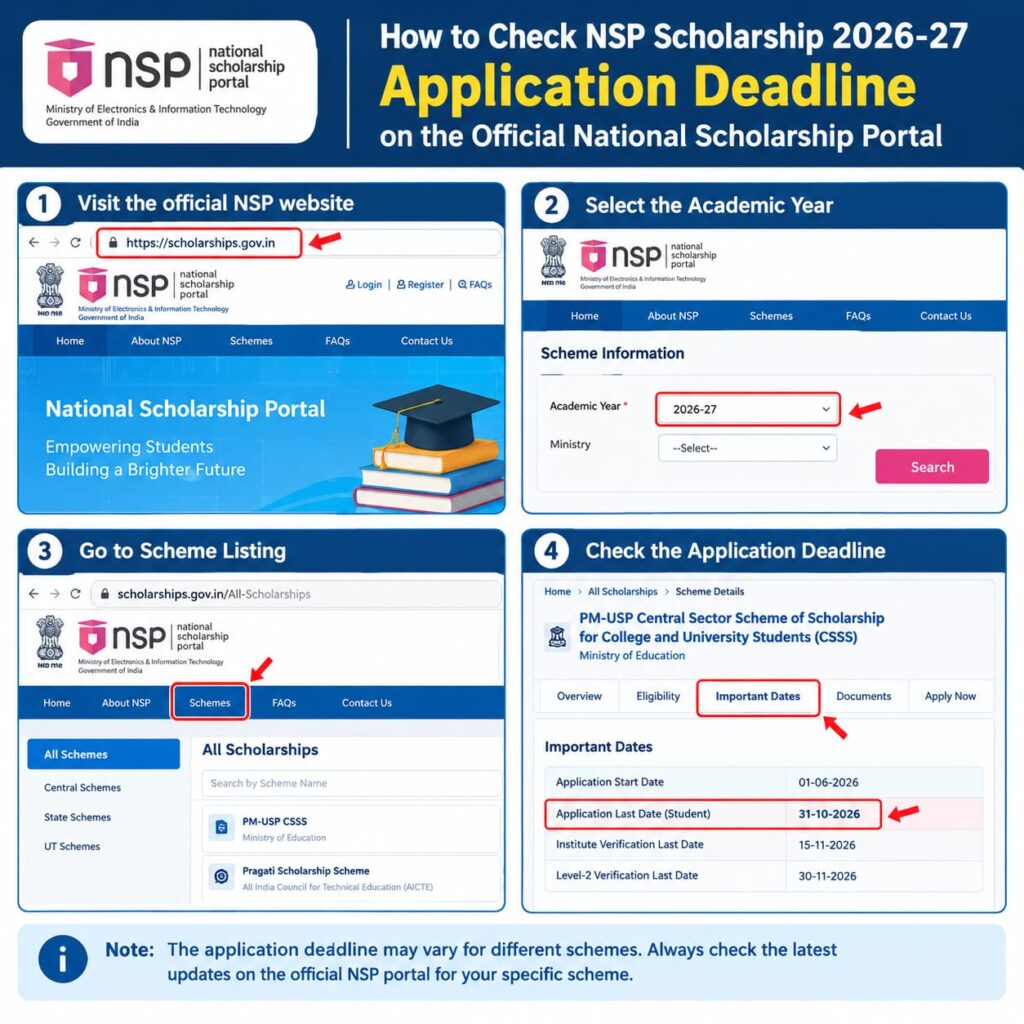
If you are unsure about the NSP scholarship last date, the safest approach is to check the scheme information directly on the government portal. You do not need to depend on forwarded WhatsApp messages, unofficial deadline lists, or videos that may contain older information.
Follow these steps to find the relevant deadline:
- Step 1: Open the official National Scholarship PortalVisit https://scholarships.gov.in/. Check that the website address is correct before entering your personal information. Avoid lookalike websites that ask for unnecessary details or charge unofficial application fees.
- Step 2: Open the scheme listingGo to the schemes section and open the list of scholarships available for academic year 2026-27. You can also visit the direct official page: https://scholarships.gov.in/All-Scholarships.
- Step 3: Find your scholarship schemeSearch for the scheme name that matches your course, category, and circumstances. Depending on your eligibility, you may find schemes administered by departments such as the Ministry of Education, AICTE, UGC, Ministry of Tribal Affairs, Department of Social Justice and Empowerment, Department of Empowerment of Persons with Disabilities, and other participating departments.
- Step 4: Read the opening and closing datesCheck the scheme’s opening date, student application deadline, and verification deadlines. If the portal provides a separate schedule for fresh and renewal applications, read the schedule that applies to you.
- Step 5: Read the official scheme guidelinesReview the scheme specifications and FAQ available through the portal. Check required academic qualifications, income conditions, eligible institutions, category requirements, documents, and renewal conditions.
- Step 6: Log in and check your applicationIf you are ready to apply, use your OTR ID and password to access the relevant application. After submitting your form, check the status and contact your institution if verification is pending.
NSP Scholarship 2026-27 Fresh Application and Renewal Process
Students generally access scholarships through a fresh or renewal application, depending on the scheme and their previous scholarship status.
What is a fresh NSP scholarship application?
A fresh application is generally used when an eligible student is applying for a scholarship for the first time under the relevant scheme. First confirm that the scheme accepts applications for your course, academic level, and category.
What is an NSP scholarship renewal application?
A renewal application is generally for a student who previously received a scholarship and wishes to continue receiving support under the same scheme. Renewal is not automatic; depending on the scheme, you must satisfy academic progression, attendance, income, and document conditions. For the 2026-27 cycle, official deadlines such as PM-USP CSSS and PM-USP Special Scholarship Scheme for J&K and Ladakh renewal applications are open until 31 October 2026.
Mandatory OTR Registration
One-Time Registration (OTR) is mandatory to avail scholarships. OTR is a unique 14-digit number issued using official identification mechanisms as required by the portal. Use the registration facility linked from the official NSP student portal (https://scholarships.gov.in/Students).
Documents Students Should Prepare
- Identification details and OTR credentials
- Recent academic marksheets and admission/enrolment details
- Institution and course information
- Income, caste/category, and domicile certificates (where required)
- Disability certificate or UDID information (where applicable)
- Bank account information and required Direct Benefit Transfer (DBT) details
- Previous scholarship details for renewal applications
Step-by-Step NSP Scholarship Application Process
| Step | What to do | What to check |
| 1 | Visit the official NSP website | Correct government portal |
| 2 | Complete OTR registration | Correct personal details and registration information |
| 3 | Find the relevant scheme | Eligibility, course, and category |
| 4 | Read the scheme guidelines | Deadline and document requirements |
| 5 | Log in to your account | Correct academic year and application type |
| 6 | Complete the form | Personal, academic, and bank details |
| 7 | Upload required documents | Correct files and legibility |
| 8 | Review and submit | No missing fields or obvious errors |
| 9 | Save the application acknowledgement | Reference details and submission status |
| 10 | Follow up on verification | Institute and other applicable authorities |
Eligibility, Application Status and Important NSP Rules
Who can apply?
Eligibility varies by scheme based on class/course, academic performance, family income limits, category, eligible institutions, and domicile requirements.
Can students apply for more than one scholarship?
From academic year 2026-27, students may apply for one merit-based scholarship scheme and one or more welfare-based scholarship schemes, subject to the eligibility criteria of the respective schemes. However, students must adhere to individual scheme rules regarding overlapping financial support.
Application Status & Verification
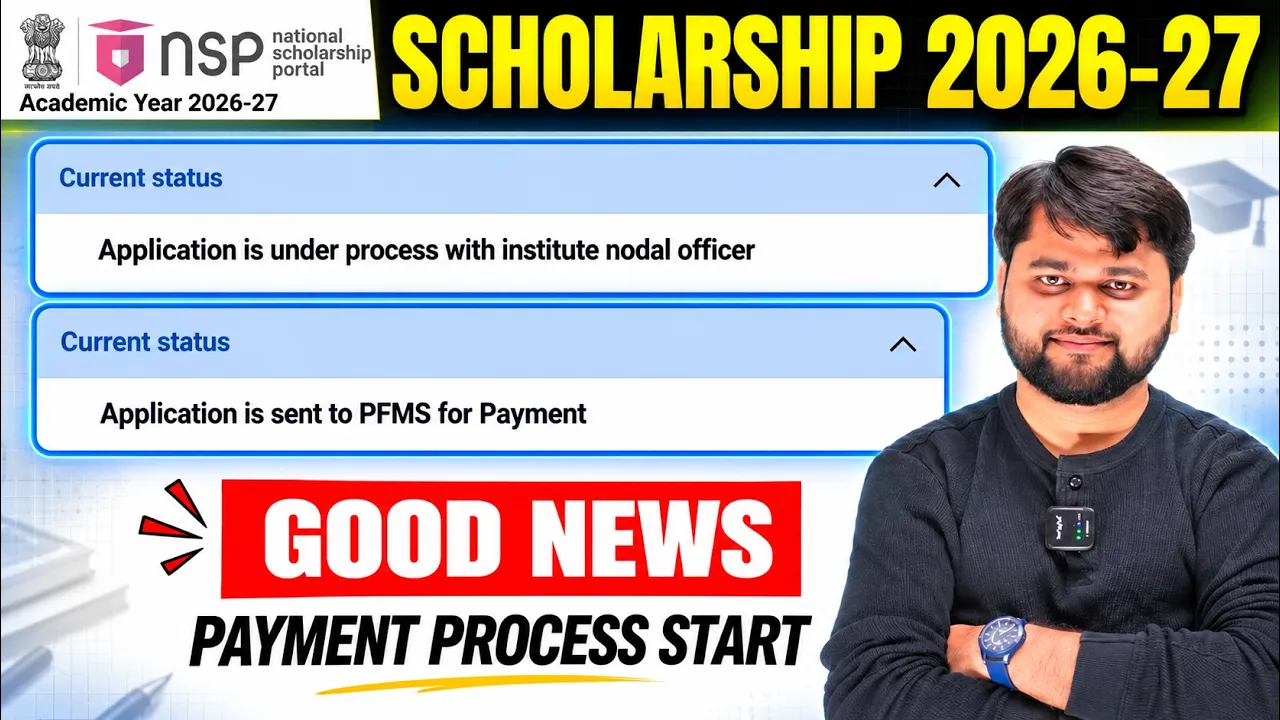
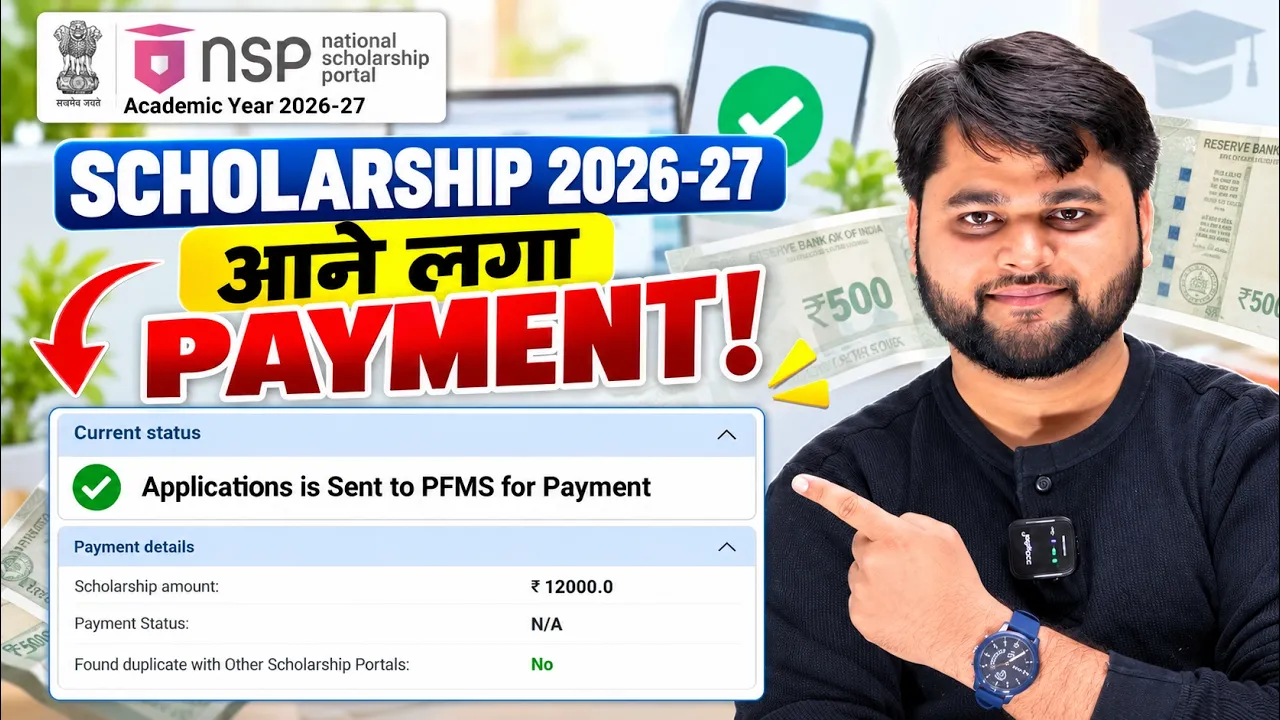
After submitting, monitor your application status via the portal. Verification happens at multiple levels (Institute level, Level-2/District/State level). If marked defective, complete the required corrections within the open correction window. Disbursement can be tracked through the Public Financial Management System (PFMS).
For readers who prefer a quick walkthrough, this video explains the full process step by step.
Common NSP Scholarship Problems and Their Solutions
Even with careful preparation, applicants frequently encounter technical or administrative hurdles during the application and verification cycles. Below are the most common issues reported by applicants along with practical steps to resolve them.
1. OTR Generation and Demographic Mismatch
- Problem: Errors during OTR registration due to discrepancies between school/college records and government identification databases (e.g., spelling differences in names or date of birth mismatches).
- Solution: Ensure that your primary identity documents match your academic record exact character-by-character before initiating OTR generation. If errors exist, update your demographic details in the official identification database prior to registration.
2. Application Marked as “Defective” by Institute
- Problem: The institute verification officer flags the application as defective due to unclear uploaded documents, wrong marks entered, or incorrect scheme selection.
- Solution: Log into your NSP account using your OTR ID. Navigate to the application status section, read the specific remarks left by the verifier, re-upload the corrected documents or update the fields, and re-submit the form before the institute verification deadline.
3. Bank Account DBT Seeding and Aadhaar Linking Issues
- Problem: Scholarship approved, but payment fails or gets stuck at the PFMS level due to unlinked bank accounts or inactive Direct Benefit Transfer (DBT) status.
- Solution: Visit your bank branch and ensure your savings account is actively seeded with your Aadhaar for NPCI/DBT mapping. Ensure the account is active, operational, and not subject to minor account transaction limits.
4. Institution Not Listed on Portal
- Problem: The student cannot find their school, college, or university in the NSP drop-down menu during form filling.
- Solution: Contact your institution’s scholarship nodal officer. The institution must register or update its profile on the NSP portal and obtain approval from the designated state/central authority before its students can select it.
Summary of Common NSP Issues, Causes, and Immediate Actions
| Issue Category | Common Cause | Recommended Immediate Action |
| OTR Validation Failure | Name/DOB mismatch with primary ID | Correct official identity records or update registration details to match academic marksheet. |
| Defective Application | Incomplete, blurred, or incorrect document upload | Log into NSP portal, review verification comments, upload legible documents, and re-submit. |
| Institute Verification Pending | Nodal officer has not reviewed submitted forms | Submit physical copies of acknowledgement and documents to your institute’s scholarship coordinator. |
| PFMS Payment Failed | Bank account not seeded with NPCI / Inactive account | Visit your bank to complete Aadhaar-NPCI DBT seeding and verify account status. |
| Scheme Not Visible | Course, category, or institution eligibility criteria unmet | Check scheme guidelines under All-Scholarships to confirm course and category compatibility. |
| Locked/Uneditable Fields | Form already submitted without checking | Request your institute nodal officer to mark the application as “Defective” so fields unlock for editing. |
Official NSP Helpdesk and Grievance Redressal
If your application remains stuck or you encounter unresolvable technical glitches on the official portal, you should raise an inquiry directly through the official National Scholarship Portal channels. Do not pay any private third party or agent claiming to guarantee scholarship approval.
Official Contact Channels
- Helpline Phone Number:
0120 - 6619540(Available from 8:00 AM to 8:00 PM on all operational days, except government holidays). - Official Helpdesk Email:
helpdesk@nsp.gov.in - PFMS Payment Helpdesk Email:
helpdesk-pfms@gov.in - PFMS Toll-Free Number:
1800 118 111 - Portal Virtual Assistant: You can also use “VANI” (the virtual assistant integrated into the official NSP home page) for automated guidance.
Important Security Reminder: When contacting the official helpdesk or submitting a grievance ticket, never disclose sensitive secret credentials such as your account password, PIN, or OTP.
Contact & Grievance Escalation Matrix
| Issue Level | Right Contact Point | Mode of Contact | Primary Responsibility |
| Institute-Level Errors | Institute Nodal Officer (INO) / Head of Institute | In-person visit / Campus Scholarship Cell | Fixing institute verification, marking forms as defective for editing, updating course profile. |
| State / District Schemes | District Nodal Officer (DNO) / State Nodal Officer (SNO) | Official contact details listed under Grievance Redressal on NSP | Level-2 verification checks, domicile issues, state-level quota queries. |
| Portal Technical Errors | NSP Technical Helpdesk | 0120-6619540 or helpdesk@nsp.gov.in | Unresolved OTR registration bugs, portal login failures, site performance issues. |
| Payment & DBT Disbursement | Public Financial Management System (PFMS) | 1800 118 111 or helpdesk-pfms@gov.in | Failed Direct Benefit Transfer (DBT) credit, bank account validation errors. |
Key Takeaways for NSP Applicants (2026-27 Cycle)
To ensure your scholarship application is processed smoothly and without unnecessary delays, keep these final essential guidelines in mind:
- Verify Official Deadlines Early: Keep track of the three critical closing dates: the Student Application Deadline (31 October 2026 for many listed schemes), the Institute Verification Deadline (15 November 2026), and the Level-2 Verification Deadline (30 November 2026).
- Mandatory OTR Registration: Complete your One-Time Registration early using your valid identification credentials before attempting to start fresh or renewal application forms.
- Double Check Scheme Category Rules: From academic year 2026-27, eligible students can apply for one merit-based scheme alongside welfare-based schemes, provided they satisfy all specific criteria.
- Follow Up on Institute Verification: Simply clicking “Submit” is not enough. Ensure your institute’s scholarship nodal officer receives your documentation and completes online verification well before the deadline.
- Ensure Active Bank Account DBT Mapping: Confirm with your bank branch that your Aadhaar is properly seeded with your active bank account for seamless NPCI/DBT credit.
Frequently Asked Questions (FAQs)
Can I edit my NSP application after clicking submit?
No, once submitted, the form is locked. However, if you notice an error, inform your institute nodal officer. If they mark your application as Defective, the form will unlock, allowing you to edit the required details and re-submit.
What should I do if my OTR registration fails?
Double-check that your name, date of birth, and demographic details match your academic records precisely. If necessary, correct your primary identity records first before completing the OTR setup.
Is a physical copy submission mandatory after online application on NSP?
It depends on your institution’s internal submission rules. Many colleges require a printed copy of the NSP acknowledgement slip along with self-attested document copies to proceed with institute verification. Always check with your institute’s scholarship cell.
What happens if my scholarship is not verified by my Institute Nodal Officer before the deadline?
If your institute fails to complete the online verification on the NSP portal by the designated institute verification deadline (e.g., 15 November 2026), your application will be automatically flagged as unverified and will not proceed to the Level-2/District/State verification stage. Always follow up directly with your college scholarship cell to ensure they complete online verification after you submit your physical document copies.
Is it possible to transfer my NSP scholarship if I change my college or course mid-way?
Generally, NSP scholarship guidelines do not allow the transfer of an active scholarship to a different course or institution mid-tenure. If you change your course or college, you may need to apply as a fresh candidate under the new institution/course for the subsequent academic year, provided the scheme permits fresh intakes and you satisfy all eligibility criteria.
How do I verify whether my bank account is successfully mapped for NSP Direct Benefit Transfer (DBT)?
Login to your net banking portal or visit your bank branch to request an Aadhaar-NPCI Mapping/DBT status check. You can also verify your DBT seeding status through your official identity portal or mobile apps (e.g., UMANG app). Ensure your bank account is active, single-operated (or primary joint account), and has no transaction limit caps that could block incoming bulk government transfers.
Conclusion: Final Checklist for a Successful NSP Application
Securing your scholarship through the National Scholarship Portal requires careful preparation, strict adherence to timelines, and proactive follow-up. By registering your One-Time Registration (OTR) early, verifying your scheme eligibility, uploading clear supporting documents, and maintaining an active, Aadhaar-seeded bank account for Direct Benefit Transfer (DBT), you can significantly reduce the chances of your application getting delayed or rejected.
Remember that completing your online submission on the NSP portal is only the first step. Always keep a copy of your acknowledgement receipt, submit your physical document set to your institution’s scholarship cell if required, and track your application status regularly up through the final Level-2 verification and PFMS payment stage.
For the latest schedule updates and official announcements, always rely directly on the official portal at https://scholarships.gov.in/. Good luck with your application!