
NSP Scholarship 2026-27 Apply Form Rejected: Big Update
Introduction
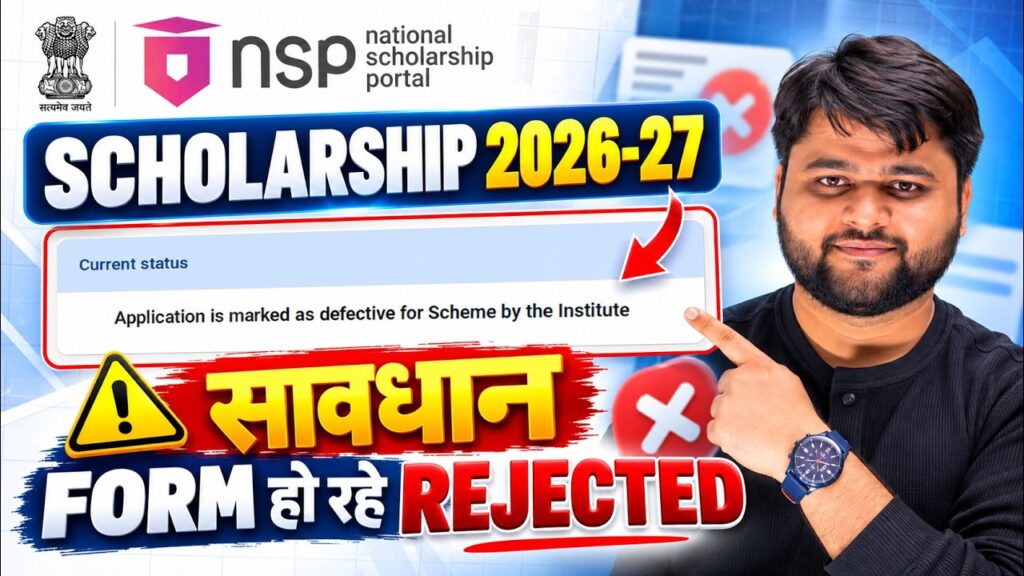
If your NSP Scholarship 2026-27 Apply Form Rejected or the application has been marked Defective, do not panic. A defective application and a rejected application are not the same thing, and the action you need to take depends on the status shown on your NSP dashboard.
For Academic Year 2026-27, the National Scholarship Portal is open and different scholarship schemes have their own application and verification timelines. For many schemes, the portal currently shows student applications up to 31 October 2026, defective application verification up to 15 November 2026, and DNO/SNO/MNO verification up to 30 November 2026. However, some schemes have earlier deadlines, so students should always check their specific scheme timeline.
The biggest lesson for students is simple: do not assume that your application is safe just because your college has verified it. An application can move through multiple verification levels, where additional mistakes may be identified.
In this article, you will learn why NSP applications become defective or rejected, what mistakes students commonly make, how to correct a defective application, and what you should do before the relevant verification deadline.
NSP Scholarship 2026-27 Form Rejected or Defective: What Does It Mean?
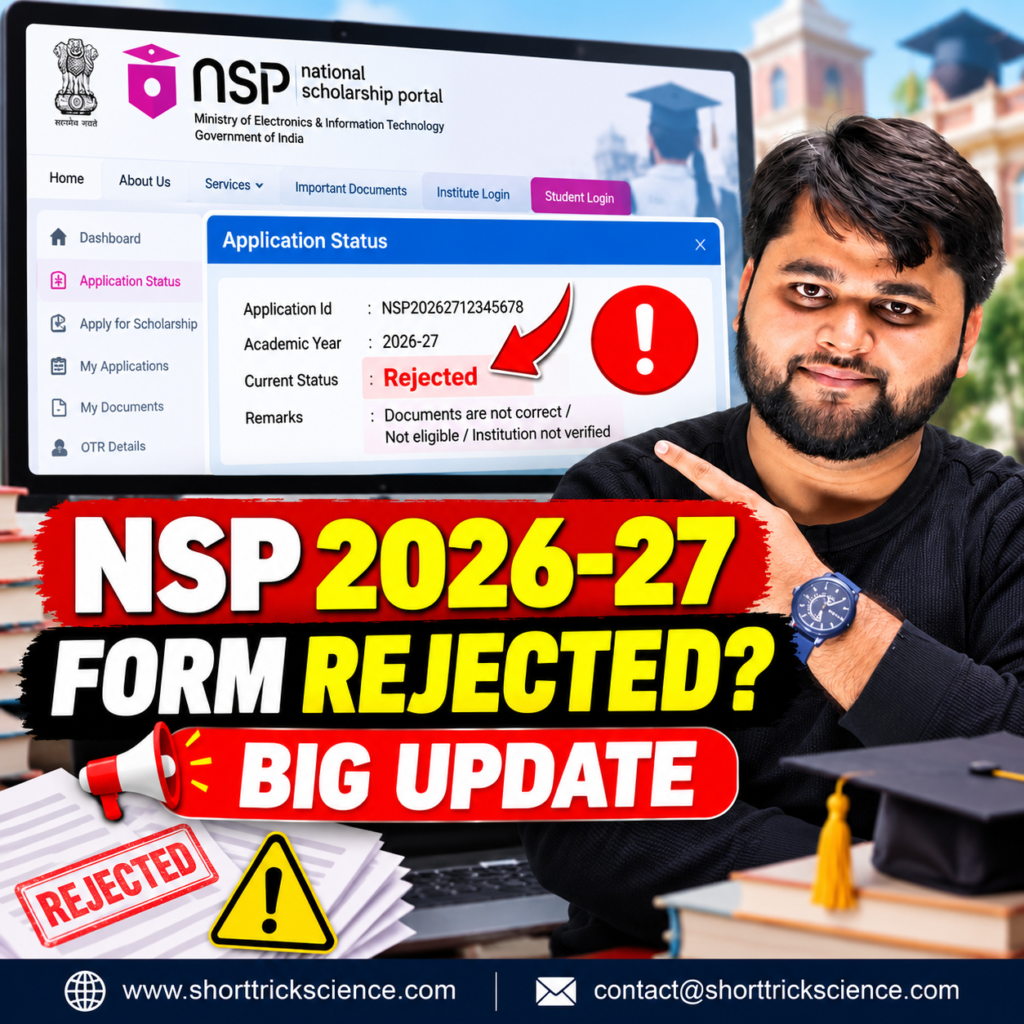
The first thing students should understand is the difference between Defective and Rejected.
When an application is marked Defective, it generally means that a verification authority has found an issue that requires correction. If the correction window is still available, the student may be able to make the required changes and resubmit the application.
A Rejected application is more serious. It means the application has not been accepted at that verification stage. The exact consequence depends on the particular scholarship scheme and the reason for rejection.
This is why students should not wait until the final days.
The official NSP portal shows separate timelines for student application, defective application verification, institute verification and higher-level verification. For example, several 2026-27 schemes currently show student applications closing on 31 October 2026, defective application verification and institute verification closing on 15 November 2026, and DNO/SNO/MNO verification closing on 30 November 2026.
Featured Snippet Answer
A defective NSP application can generally be corrected only while the relevant correction/defective verification window is open. If an issue is identified after that stage, the application may be rejected instead. Students should check their NSP status and scheme-specific timeline immediately.
Quick Summary
| NSP Application Status | What It Means | What Student Should Do |
|---|---|---|
| Submitted | Application has been submitted | Keep checking status |
| Institute Verified | College/institute has verified it | Continue monitoring |
| Defective | A correction is required | Correct the issue and resubmit within the allowed window |
| Rejected | Application was not accepted at a verification stage | Check rejection reason and scheme rules |
| Pending | Verification is still in progress | Wait, but monitor regularly |
| Verified by Higher Level | Application has passed another verification stage | Continue checking final processing/payment status |
Important: The exact status labels and actions can vary by scheme and verification stage.
Why Is NSP Scholarship 2026-27 Apply Form Becoming Defective or Rejected?
One of the biggest mistakes students make is assuming that college verification means the application is completely error-free.
That is not necessarily the case.
An application may first be checked by the institute and then move to another verification authority. During a later-level verification, information that was not noticed earlier may be identified.
For example, a student may enter an incorrect passing year/course year, provide inconsistent academic information, upload an incorrect document, or enter information that does not match the supporting records.
The problem becomes more serious when the student notices the issue only near the end of the correction period.
Common mistakes to check
- Incorrect passing year or course year
- Wrong academic details
- Mismatch between application and certificates
- Incorrect category information
- Incorrect income details
- Wrong bank account information
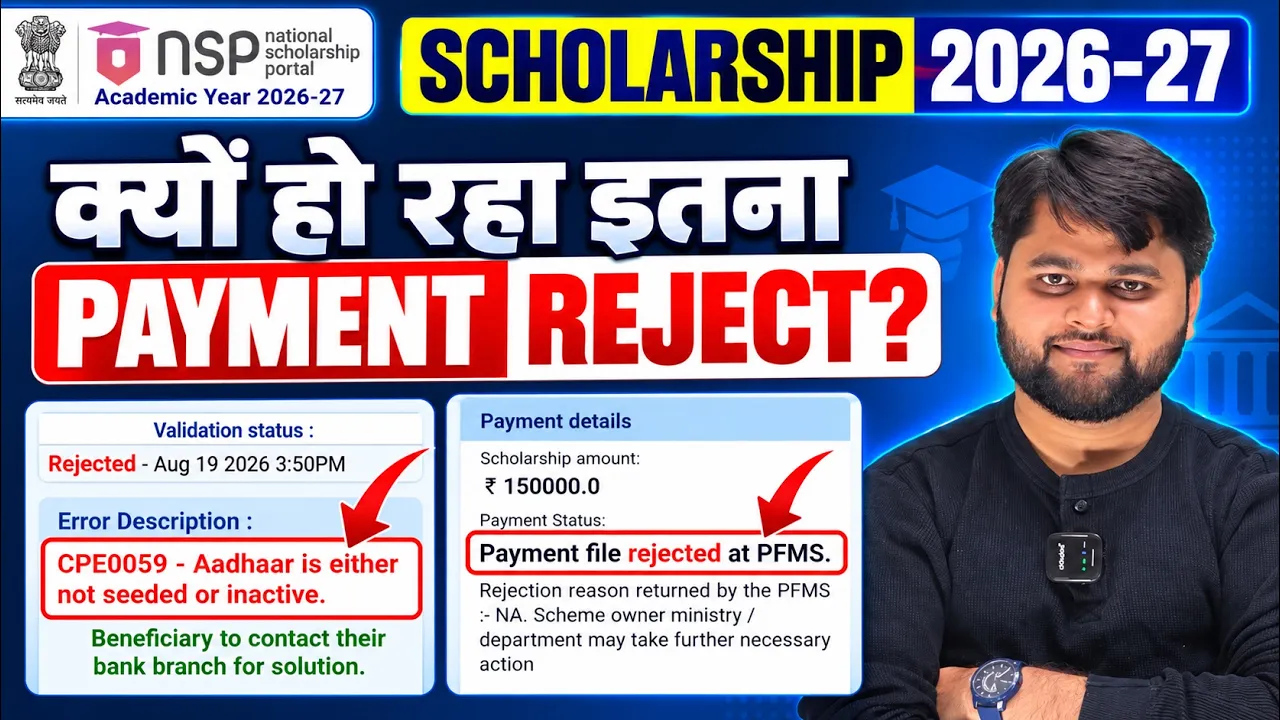
- Bank/Aadhaar-related issues
- Incorrect or unclear documents
- Invalid or outdated certificate
- Incorrect bonafide certificate, where required by the scheme
- Wrong course or institution details
- Information that does not match official records
- Mistakes made while filling the form through a cyber café
Students should remember that the responsibility for the information submitted in the scholarship application ultimately rests with the applicant. Even if somebody else fills the form, the student should check the complete application before final submission.
The official NSP portal also states that an OTR number is required to apply for scholarships on NSP, so students should use their correct OTR and application details.
NSP Scholarship 2026-27 Apply: What Should You Do If Your Form Is Defective?
If your NSP application is showing Defective, the most important thing is to check the reason/remark carefully.
Do not simply open the application and submit it again without understanding what went wrong.
Suppose the verification authority has pointed out an incorrect academic entry. In that case, you need to verify the correct information from your original academic documents before making the correction.
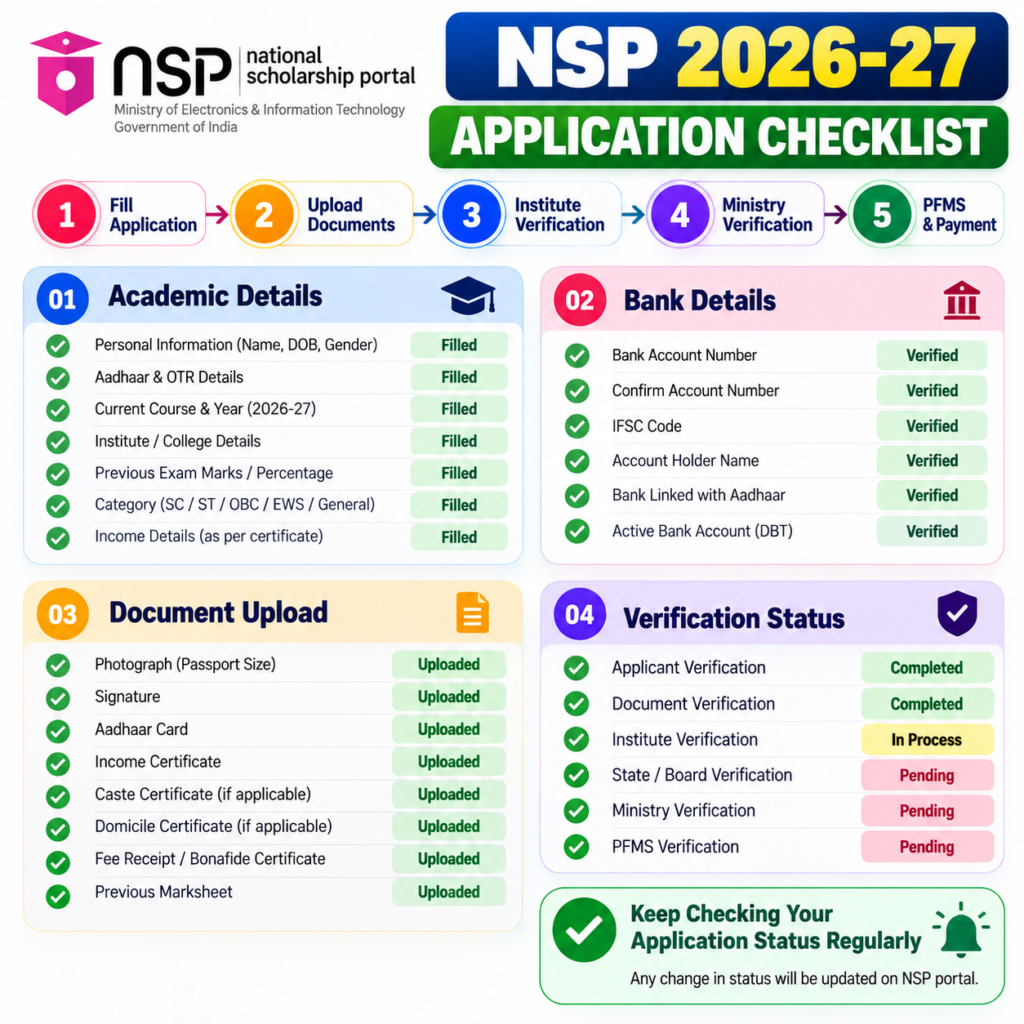
The process can broadly be understood like this:
- Login to your NSP account.
- Open your 2026-27 scholarship application.
- Check the current application status.
- Read the defective remark carefully.
- Identify the exact field/document that needs correction.
- Compare the information with your original documents.
- Correct the information where the portal allows correction.
- Upload the correct document if required.
- Review the complete application again.
- Resubmit within the permitted correction period.
- Save the updated application/status for your records.
- Continue checking the verification status.
Do not assume that simply resubmitting the application means the process is complete.
Your application still needs to pass the applicable verification stages.
Step-by-Step Process
| Step | What to Do | Why It Matters |
|---|---|---|
| 1 | Login to NSP | Access your application |
| 2 | Check status | Know whether it is pending, defective or rejected |
| 3 | Read the remark | Understand the actual problem |
| 4 | Verify your documents | Avoid making another mistake |
| 5 | Correct the application | Fix the identified error |
| 6 | Upload the correct document | Support the corrected information |
| 7 | Review everything | Catch additional mistakes |
| 8 | Resubmit | Send the corrected application |
| 9 | Save proof | Keep application/status records |
| 10 | Monitor status | Ensure the application progresses |
NSP Scholarship 2026-27 Apply Last Date and Verification Timeline
Students searching for nsp scholarship 2026-27 apply last date should be careful because there is no single deadline applicable to every scholarship scheme on NSP.
The official National Scholarship Portal currently lists different timelines for different schemes.
For example, several schemes show:
- Student application: 31 October 2026
- Defective application verification: 15 November 2026
- Institute verification: 15 November 2026
- DNO/SNO/MNO verification: 30 November 2026
But some schemes have earlier dates. For instance, certain renewal applications and schemes currently show September or October deadlines.
The National Scholarship Portal 2026-27 should therefore be treated as the final source for your particular scholarship scheme rather than relying on a date circulating on social media.
Another important point is that the official portal says the Academic Year 2026-27 portal opened from 1 June 2026.
What Students Should Do Now
If your application is already submitted:
Do not wait for the last date.
Check whether it is:
- Pending at institute level
- Verified by institute
- Defective
- Pending at another verification level
- Rejected
If it is pending with your institute, contact the appropriate institute/nodal office and ask them to check the application.
If it is defective, read the remark and take action within the permitted period.
If it has already been rejected, first understand the reason instead of assuming that the application can automatically be corrected.
For readers who prefer a quick walkthrough, this video explains the full process step by step.
NSP Scholarship 2026-27 Apply: Mistakes Students Should Avoid
A major problem with scholarship applications is that students sometimes focus only on completing the form.
The better approach is to focus on accuracy.
If you are applying for a fresh scholarship, check all information before final submission. If you are applying for renewal, compare the current information with your previous scholarship records and current academic documents.
Students applying for NSP Scholarship 2026-27 Apply for PG should also pay particular attention to course, university, academic year and admission-related information because these details need to match the documents submitted with the application.
Similarly, students searching for NSP Scholarship 2026-27 Apply Bonafide Certificate should use the bonafide/document format required by their specific scheme or institution instead of uploading a random certificate.
Problem vs Solution
| Problem | What You Should Do |
|---|---|
| Form is defective | Read the exact defective remark |
| Incorrect passing year | Check the original marksheet/certificate |
| Course information is wrong | Match it with official college records |
| Document uploaded incorrectly | Replace it if correction is available |
| Bonafide issue | Obtain the correct certificate from the institution |
| Application pending at college | Contact the institute/nodal officer |
| Higher-level verification pending | Keep monitoring the NSP dashboard |
| Form rejected | Check the rejection reason and applicable scheme rules |
| Cyber café filled the form | Personally verify every field |
| Deadline is approaching | Complete corrections immediately |
official National Scholarship Portal
Government Scholarship Rules 2026-27 and multiple scholarship rules
Can NSP Scholarship 2026-27 Form Be Corrected After It Becomes Defective?
Yes, if the application is marked defective and the relevant correction window is still open, students may be able to correct the identified issue and resubmit the application. The exact correction facility depends on the scheme and portal timeline. If the correction period has ended, further action may not be available through the same process.
FAQ
1. Why is my NSP Scholarship 2026-27 application defective?
Your application may be marked defective if a verification authority identifies an error or mismatch in your application, documents or eligibility-related information. Check the remark shown against your application.
2. Can I correct a defective NSP application?
If the correction window is open and the portal provides the correction option, you can correct the identified mistake and resubmit the application.
3. Is defective and rejected the same thing in NSP?
No. A defective application generally indicates that an issue needs correction, while rejection means the application has not been accepted at that verification stage.
Why was my NSP form rejected after college verification?
College verification is one stage of the process. A later verification authority may identify an error that was not detected earlier. Therefore, college verification does not necessarily guarantee final approval.
What is the NSP Scholarship 2026-27 apply last date?
The deadline depends on the scholarship scheme. Several schemes currently list 31 October 2026 as the student application deadline, but other schemes have different timelines. Always check your specific scheme on NSP.
What should I do if my NSP application is pending at college?
Contact your institute’s scholarship/nodal office and ask them to check the application. Continue monitoring your NSP dashboard rather than assuming the application has been verified.
Is OTR required for NSP Scholarship 2026-27?
Yes. The official NSP portal states that a One Time Registration (OTR) number is required to apply for scholarships on NSP.
Can I apply for NSP Scholarship 2026-27 for PG courses?
Yes, where the relevant PG scholarship scheme is available and you meet its eligibility conditions. For example, the official NSP currently lists the National Scholarship for Post Graduate Studies with a 2026-27 application timeline.
Conclusion
The biggest NSP Scholarship 2026-27 apply update for students is not simply about submitting the form before the deadline. You also need to make sure that the information and documents submitted in the application are correct.
An application may pass one verification stage and still face an issue at a later stage. That is why students should regularly check their NSP status, read every remark carefully and take action whenever a defective application appears.
If your application is currently defective, do not panic and do not ignore it. First understand the reason, make the required correction if the portal allows it, resubmit the application and continue checking its status.
And if your application is still pending, do not wait until the last day to contact your institute or concerned authority.
For the latest scheme-specific dates and official updates, always check the official National Scholarship Portal rather than relying only on social media posts or messages circulating in student groups.




One Response