NSP Scholarship 2026-27 Bonafide Certification: What It Is, Who Issues It and How to Use It
Introduction
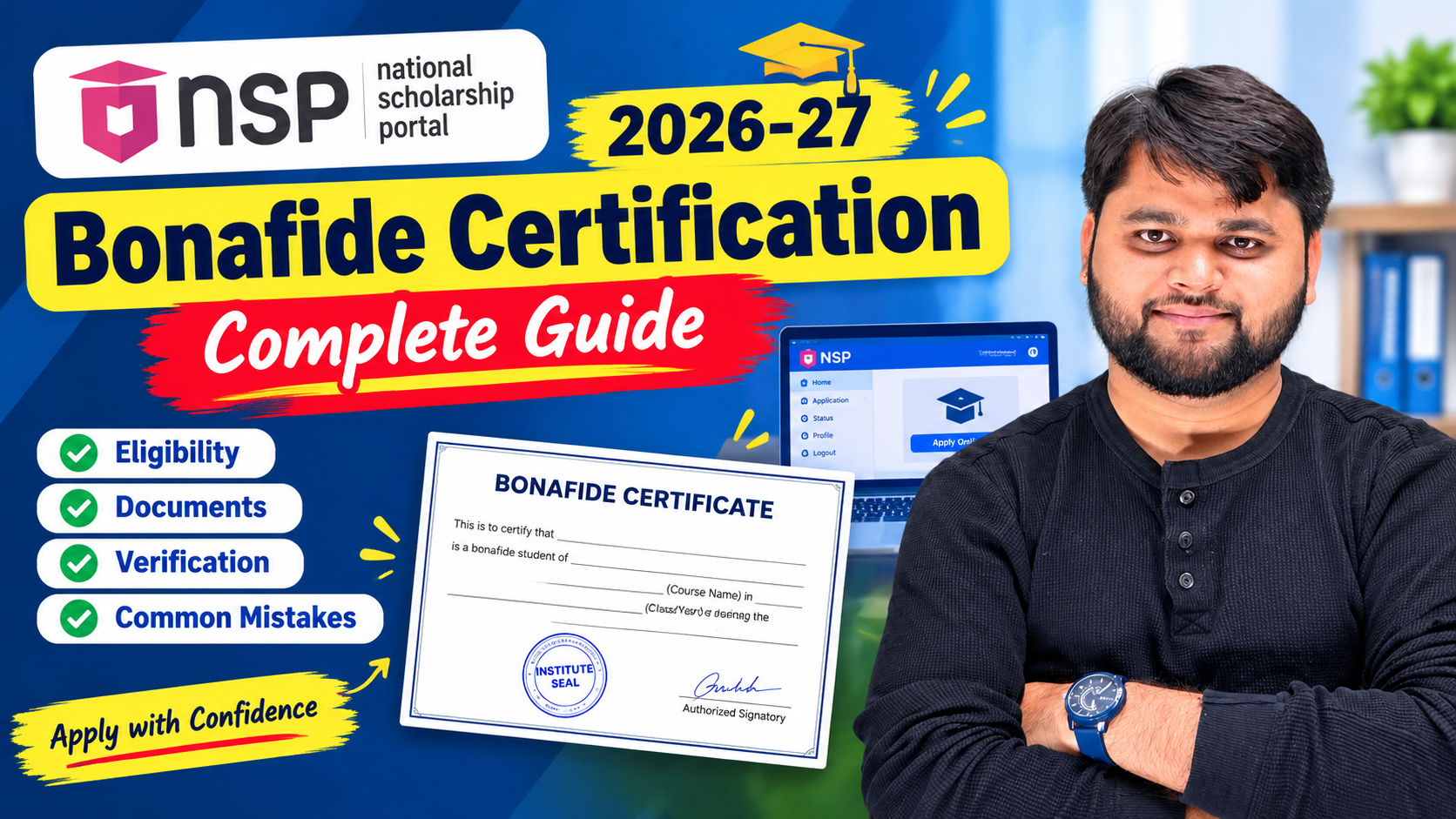
If you are applying for a National Scholarship Portal scheme this year, the NSP scholarship 2026-27 bonafide certification is the document that proves you are a real, currently enrolled student at your school or college. You get it from your own institution, usually from the principal’s office or the college office. You then upload a clear scan of it on the NSP application form where your scheme asks for it.
Many students lose time here, and the cause is rarely the certificate itself. They ask for it too late, the name does not match their Aadhaar, or the scan is too blurry to read.
This guide covers what a bonafide certificate is, what it should contain, how to get one quickly, how to upload it, and how to fix the usual problems. It also covers how it connects to institute verification, which is the step that decides whether your application moves forward.
What Is a Bonafide Certificate for NSP Scholarship 2026-27?
A bonafide certificate is a short letter from your institution. It confirms that you are a genuine student, enrolled in a particular course and year, in the current academic session. The word “bonafide” means genuine or in good faith.
For the NSP scholarship, this letter helps in two ways:
- It supports your claim that you are studying in 2026-27, which is what the scholarship money depends on.
- It gives the institute a record to compare against when its nodal officer verifies your application.
Many students confuse this with a fee receipt, an admission letter or a marksheet. These are different documents. A fee receipt shows you paid. An admission letter shows you were offered a seat. A bonafide certificate says you are studying there now.
Requirements are not identical across schemes. Some ask for a bonafide upload, some accept an admission or fee proof, and some rely mainly on the institute’s own verification. Always read the guidelines for your particular scheme before assuming anything.
Quick Summary
| Point | What You Need to Know |
|---|---|
| Document name | Bonafide certificate (student certificate) |
| Who issues it | Principal, headmaster, registrar or authorised office staff |
| Purpose on NSP | Proves current enrolment for 2026-27 |
| Format | Printed on institute letterhead, with signature and seal |
| Upload type | Scanned PDF or image, as the portal specifies |
| Needed for | Fresh and renewal applications where the scheme asks for it |
| Biggest risk | Name, course or session not matching your other records |
| Where to apply | Official NSP portal (scholarships.gov.in) |
Who Needs a Bonafide Certificate, and When Should You Get It?
Most students applying through NSP will end up needing one. That includes school students applying for pre-matric schemes and college students applying for post-matric and merit-based schemes. If you are a renewal applicant, check whether your scheme wants a fresh certificate for the new year. Last year’s letter will usually show the wrong session.
The right time to ask is before you open the application form. Many offices take a day or two, and some take longer during admissions and exam season. If you ask on the last day, you are at the mercy of whoever is at the desk.
A few practical tips:
- Ask for two or three copies. You may need one for another scheme or for a state portal.
- Ask the clerk to check your name spelling against your Aadhaar before printing.
- If your institute has a student portal, check whether it can generate the certificate on its own.
- Keep the original safe. Upload only the scan.
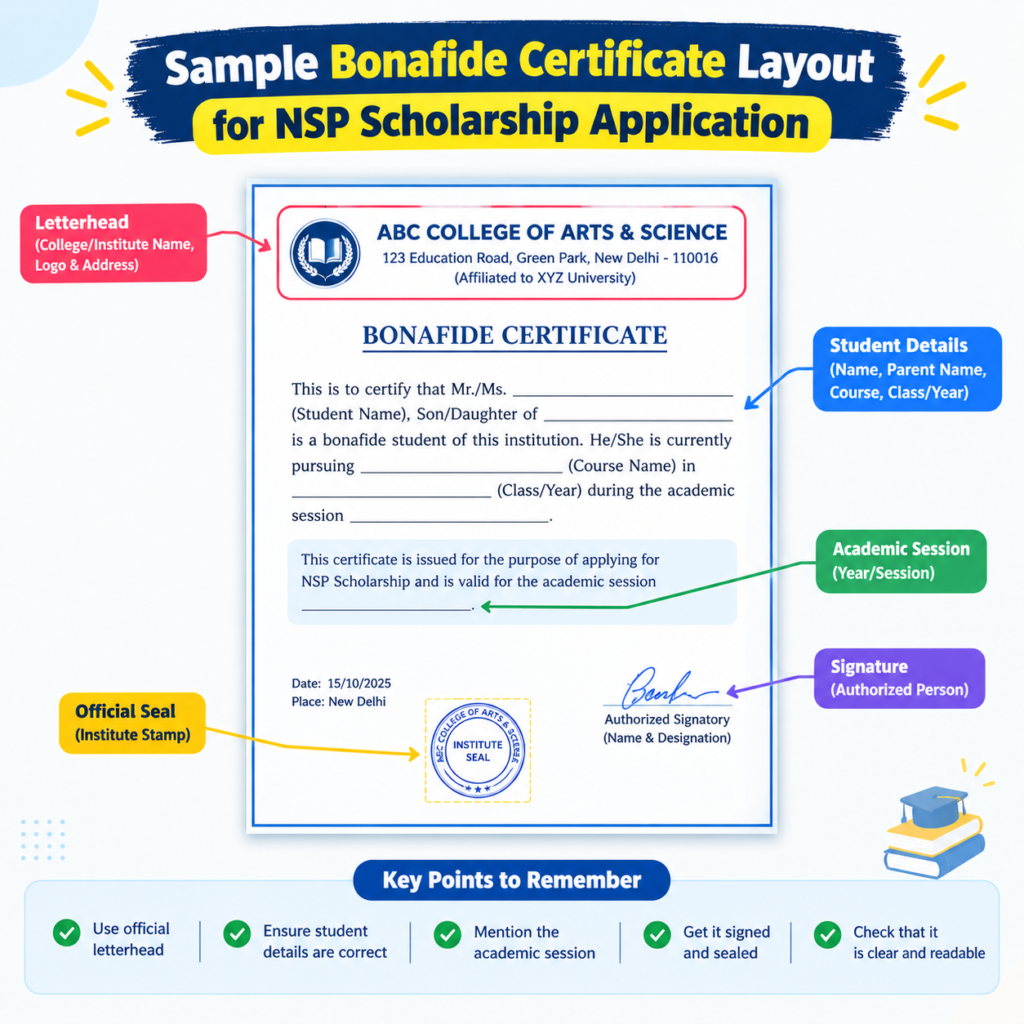
What a Correct Bonafide Certificate Should Contain
This is where most rejections begin. A certificate that looks official but leaves out key details can still be sent back.
A good bonafide certificate for the NSP scholarship should clearly show:
- Institute name and address, on the official letterhead
- Student’s full name, spelled exactly as on your Aadhaar
- Father’s or guardian’s name, if your institute normally includes it
- Course and class or year, such as “B.A. 2nd Year” or “Class 10”
- Academic session, which must read 2026-27
- Roll number, enrolment number or admission number
- Date of issue
- Signature and name of the issuing authority, with designation
- Official seal or stamp
Some state schemes prescribe their own format. If yours does, follow that format. Otherwise, a clean standard format from your institution is usually fine, as long as the details are complete and legible.
A common mistake: the certificate says “2025-26” because the clerk reused an old template. A wrong session is enough to cause trouble, so check this line before you leave the office.
Step-by-Step Process
| Step | What to Do | Quick Tip |
|---|---|---|
| 1 | Complete your One-Time Registration (OTR) on NSP | Keep your Aadhaar-linked mobile number active |
| 2 | Read your scheme’s guidelines | Confirm whether a bonafide upload is required |
| 3 | Request the certificate from your institute | Submit a short written request if the office asks |
| 4 | Check every detail before accepting it | Name, course, year, session, seal and signature |
| 5 | Scan it clearly | Use a scanner or a scanning app in good light |
| 6 | Reduce the file size if needed | Keep to the size limit shown on the upload screen |
| 7 | Upload it in the correct field | Do not put it under the fee receipt slot |
| 8 | Preview, then final submit | Download your acknowledgement copy |
| 9 | Follow up with your institute | Ask the nodal officer to verify your application |
How to Upload the Bonafide Certificate on NSP, Step by Step
Here is the usual flow once you are ready to fill the form.
1. Log in with your application ID and password. If you finished OTR earlier, use those credentials and open the 2026-27 application.
2. Fill in the personal, academic and bank details first. Do not rush to the upload page. Many errors come from details entered carelessly in the earlier sections.
3. Go to the document upload section. Each field is labelled. Find the one meant for the bonafide certificate or institute proof, depending on your scheme.
4. Check file type and size. The portal normally accepts a limited set of formats and has a small size cap, often in the region of a few hundred KB. Follow whatever limit appears on your upload screen, since it can change.
5. Upload and preview. Open the preview and read the certificate on screen. If you cannot read the text easily, neither can the verifying officer.
6. Save the draft and review the whole form. Check that the name and course on your certificate match what you typed.
7. Submit the form and note your application ID. After that, contact your institute so the nodal officer can verify it.
For readers who prefer a quick walkthrough, this video explains the full process step by step.
Why Bonafide Certificates Get Rejected, and the Institute Verification Link
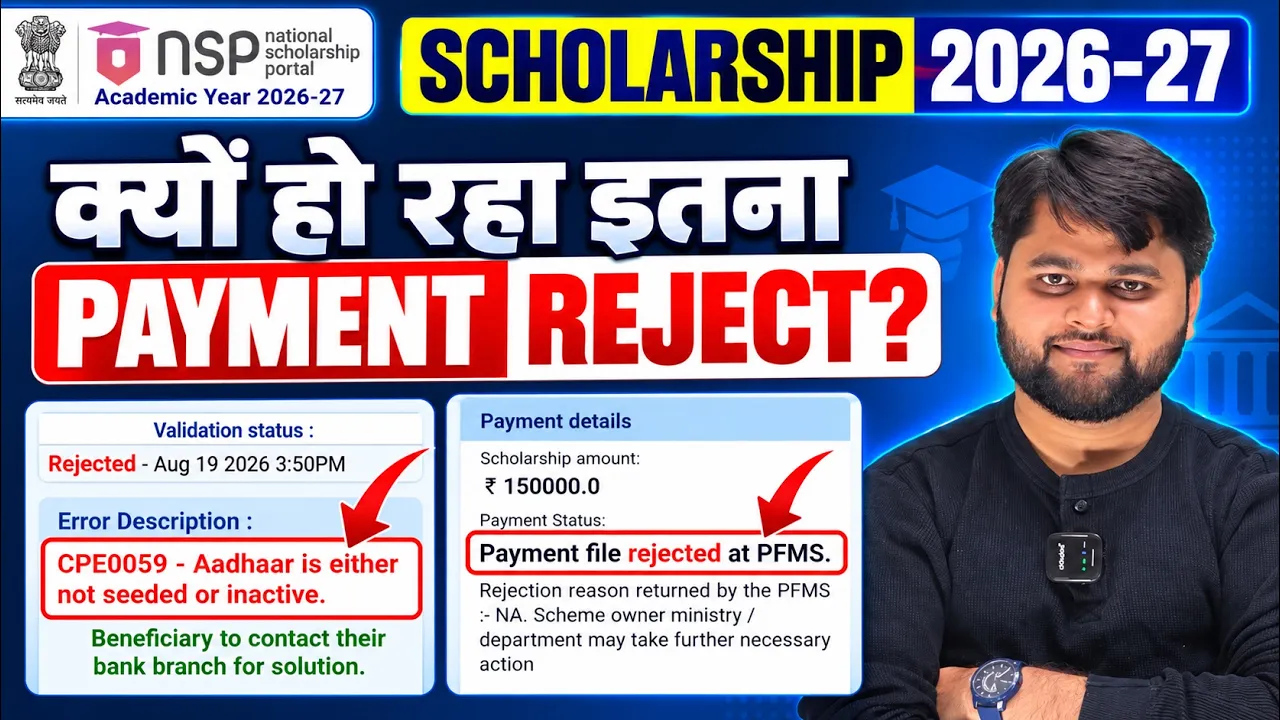
Uploading the certificate is not the finish line. On NSP, your application is verified by your institute first, and then it moves to higher levels such as district or state, depending on the scheme. If the institute sees a mismatch, it can send the application back as a “defect” or reject it.
The most common reasons are simple:
- The name on the certificate differs from Aadhaar, even by a spelling or an initial.
- The session or class is wrong or missing.
- The seal or signature is absent or unreadable.
- The scan is cropped, dark or rotated.
- The student uploaded the wrong document in the wrong slot.
- The certificate is old, or issued for a different academic year.
Watch your application status after submitting. If it shows a defect, read the remark carefully. Fix exactly what it names, then resubmit within the correction window.
Problem vs Solution
| Problem | Why It Happens | Solution |
|---|---|---|
| Name mismatch | Office used a different spelling | Ask for a corrected copy, matching Aadhaar exactly |
| Wrong session printed | Old template reused | Request reissue with “2026-27” |
| Missing seal or signature | Clerk forgot or authority absent | Take it back and have it stamped and signed |
| File too large | High-resolution scan | Compress it, or rescan at lower quality |
| Blurry text | Poor lighting or phone shake | Rescan flat, in daylight, with the camera steady |
| Uploaded in wrong field | Rushed form filling | Delete and re-upload under the correct label |
| Office refuses to issue | Dues pending or admission incomplete | Clear the issue, or contact the principal in writing |
| Institute not verifying | Nodal officer unaware or busy | Visit with your application ID and request verification |
Always follow the instructions and scheme guidelines published on the official National Scholarship Portal, since document rules and dates can differ between schemes.
“official National Scholarship Portal” → https://scholarships.gov.in/
If you are also exploring options beyond government schemes, our guide to top private scholarships for Indian students explains how to find and apply for them, and the same bonafide certificate often works there too.
What is a bonafide certificate for NSP?
A bonafide certificate is a letter issued by your school or college confirming you are currently enrolled in a specific course and session. For NSP scholarship 2026-27, you get it from your institute, check that the details match your Aadhaar, scan it clearly and upload it. (47 words)
FAQ
Is a bonafide certificate compulsory for NSP scholarship 2026-27?
It depends on the scheme. Many schemes list it among required documents, while others rely on institute verification or accept admission and fee proof. Check your scheme’s guidelines on the portal.
Who can sign the bonafide certificate for NSP?
The head of the institution, such as the principal or headmaster, or an authorised official like the registrar. It needs a signature and an official seal.
Can I use last year’s bonafide certificate for renewal?
Usually not. The session will read 2025-26, and the institute needs proof of enrolment for the current year. Ask for a fresh one.
What size should the bonafide certificate be for NSP upload?
The portal sets a file size limit and accepted formats on the upload screen. Stay within that limit. If your scan is too large, compress it without making the text unreadable.
Is there a fixed NSP format for the bonafide certificate?
For most schemes, there is no single universal format, and your institute’s standard format is usually acceptable if it includes all required details. Some state schemes prescribe a format, so check yours.
What if my college refuses to issue the certificate?
Ask politely in writing, and mention the scholarship deadline. If dues or an incomplete admission are the reason, clear them first. If you still face trouble, approach the principal directly.
Do I need to submit a hard copy to the institute too?
Often the institute asks for a printout of the submitted application along with documents for verification. Ask your nodal officer what your institute requires.
My application shows a defect about the bonafide. What now?
Read the remark, get a corrected certificate, re-upload it in the right field and resubmit within the correction window.
Can a bonafide certificate be digital?
Some institutes issue digitally generated certificates with a verification code or QR. If yours does, print it, check that the seal or authentication is visible, and scan that copy.
Conclusion
The NSP scholarship 2026-27 bonafide certification is a small document, but it decides whether your application is accepted smoothly or sent back. Get it early, check every line, scan it clearly, and upload it where the portal asks.
Do not leave it for the final days, because offices get busy and corrections take time. With the deadline close for many schemes, a few minutes spent checking your certificate now can save you a lot of stress later. Confirm your own scheme’s exact date on the official portal.
Good luck with your application.