
HDFC Scholarship Interview Questions 2026-27 | Apply Online & Full Details
Introduction
If you have applied or are planning to apply for the HDFC Scholarship 2026-27, the interview stage can be just as important as the application form. In this guide, you will find the most important HDFC Scholarship Interview Questions 2026-27, practical ways to answer them, the HDFC Scholarship 2026-27 apply online process, eligibility basics, documents, selection process and common problems students face.
The HDFC Bank Parivartan’s Educational Crisis Scholarship Support (ECSS) Programme is designed to provide financial assistance to students who are academically capable but facing financial difficulty or a personal/family crisis. Recent programme information indicates support can extend from school level through postgraduate study, with assistance of up to ₹75,000 depending on the category. HDFC Bank’s own impact assessment describes the selection as a multi-stage process involving initial shortlisting, document verification, a personal interview and final selection.
One important point before you apply: do not prepare memorised answers for the interview. The strongest answers are honest, specific and connected to your actual academic journey, financial situation and future goals.
HDFC Scholarship Interview Questions 2026-27: What Can Be Asked?
The main purpose of the interview is not simply to test whether you can speak good English. A scholarship interview can help assess whether your application reflects your real academic situation, financial circumstances, goals and need for support.
A recent interview account published by Buddy4Study describes an HDFC ECSS interview as a telephonic interview after document verification. The candidate reported that the questions focused mainly on academic performance, financial background, achievements and genuine need.
Therefore, prepare for questions around these areas:
- Your introduction
- Your education and academic performance
- Why you applied for the scholarship
- Your family and financial circumstances
- Personal or family challenges
- Academic achievements
- Career goals
- How the scholarship will help you
- Your contribution to society
- Your ability to handle challenges
- Your field of study
- Your future plans
Important HDFC Scholarship Interview Questions
1. Tell me about yourself.
This is usually one of the most important opening questions.
Do not give a long biography. Keep your response around 30–60 seconds.
A good structure is:
Name → current course/class → academic performance → achievement/interest → career goal
For example:
“My name is Rahul. I am currently pursuing B.Tech in Computer Science. I have maintained good academic performance and have participated in technical projects and college activities. My goal is to build a career in software development and use technology to solve practical problems.”
Change the example according to your actual background.
2. Why did you apply for the HDFC Scholarship?
The interviewer wants to understand your actual need.
Do not simply say:
“Because I need money.”
Instead, explain what financial support would change for you.
For example:
“I applied because financial difficulties are making it challenging for my family to manage my educational expenses. This scholarship would help me continue my studies without putting additional financial pressure on my family.”
Keep the answer truthful.
3. What inspired you to choose your current field of study?
Your answer should show that you have a genuine interest in your course.
You can talk about:
- A teacher
- A family member
- A personal experience
- A subject you enjoyed
- A real-world problem
- A professional you admire
- A project that influenced you
Avoid inventing a story just because it sounds impressive.
4. Tell us about your academic achievements and extracurricular activities.
Mention achievements that are actually relevant to you.
These could include:
- Good marks
- Academic awards
- Competitions
- Projects
- Certifications
- Sports
- Volunteering
- Leadership activities
- Cultural activities
- College responsibilities
If you do not have major awards, don’t panic.
You can explain how you improved academically, completed a difficult project or contributed to an activity.
5. How will the HDFC Scholarship support your education?
This is a very important question.
Be specific about where the financial support will help.
For example:
- Tuition fees
- College fees
- Books
- Study material
- Examination expenses
- Educational equipment
- Travel related to education
- Other genuine academic expenses
Do not claim that you will use the money for something that is unrelated to education.
6. Describe a challenging situation you overcame. What did you learn?
The interviewer is interested in your problem-solving ability.
Use this simple structure:
Situation → Problem → Action → Result → Lesson
For example, you could describe an academic setback, financial difficulty, family challenge or difficult project.
The important part is not how dramatic the situation was. It is what you did and what you learned.
7. What are your long-term education and career goals?
Don’t give a vague answer such as:
“I want a good job.”
Instead, explain:
- What you want to study next
- Which career you are targeting
- Why you selected that career
- How your current education contributes to that goal
Your plans can change later. The interviewer mainly wants to see whether you have direction.
8. How will your education contribute to your community or society?
Think beyond yourself.
For example:
A medical student may want to improve healthcare access.
An engineering student may want to work on affordable technology.
A commerce student may want to support small businesses.
A teacher-training student may want to improve learning opportunities for children.
Your answer should connect your education with a realistic contribution.
9. Can you discuss a book, research paper or topic related to your field?
This question is particularly relevant for higher-education students.
Before the interview, prepare at least:
- One book
- One recent development
- One important topic from your course
- One project or assignment you completed
You should be able to explain the topic in simple language.
10. How do you manage your time between academics and extracurricular activities?
Explain your actual routine.
For example:
“I divide my study schedule according to priority. I complete important academic work first and use fixed time slots for extracurricular activities. Before examinations, I reduce extracurricular commitments so that my studies remain the priority.”
A practical answer is better than an unrealistic “I study all day” response.
11. Have you faced any obstacle that affected your academic performance?
Be honest.
If you experienced:
- Financial difficulty
- Family responsibilities
- Health-related circumstances
- Change of school/college
- Lack of study resources
- Personal crisis
- Other genuine difficulties
explain briefly how it affected your studies and what you did to address it.
Don’t exaggerate your circumstances.
12. Tell us about a person who has significantly influenced your academic journey.
This could be:
- Parent
- Teacher
- Mentor
- Sibling
- Professor
- Professional
- Someone from your community
Explain what the person did and how it influenced you.
Simply saying “my father inspires me” is not enough. Explain why.
13. What are the biggest challenges students face in your field today?
Research your field before the interview.
For example, students from technology-related fields could discuss rapidly changing technologies and the need for continuous learning.
Students in other fields should identify challenges specific to their discipline.
14. How do you stay motivated during difficult academic periods?
Give a real example.
You can discuss:
- Setting smaller goals
- Following a timetable
- Speaking with mentors
- Taking short breaks
- Tracking progress
- Remembering your long-term goal
The interviewer is looking for resilience rather than a perfect motivational speech.
15. Give an example of when you demonstrated adaptability and an open mind.
Think about a situation where something did not go according to plan.
Maybe:
- You changed your study method
- Your project requirements changed
- You joined a new environment
- You learned a new skill
- You worked with people with different opinions
Explain what changed and how you responded.
16. What recent technological development or trend interests you in your field?
This question requires preparation.
Choose one recent development and understand:
- What it is
- Why it matters
- Its benefits
- Its limitations
- Its possible future impact
Don’t mention five technologies without understanding any of them properly.
17. What steps do you take to stay updated about developments in your field?
You can mention genuine sources such as:
- Academic journals
- Books
- Online courses
- Professional websites
- Seminars
- Webinars
- Faculty guidance
- Industry news
- Educational YouTube channels
The key is to show that learning doesn’t stop at your textbook.
18. Describe a time when you had to make a difficult decision.
Explain:
What was the decision? Why was it difficult? What options did you consider? What did you choose? What happened afterward?
The interviewer is interested in your thought process.
19. Why should we select you for this scholarship?
This can be one of the toughest questions.
Don’t say:
“Because I deserve it more than everyone else.”
Instead, explain three things:
Academic commitment + genuine financial need + future potential
Your answer should show why the scholarship would make a meaningful difference to your education.
20. What will you do if you don’t receive the scholarship?
This question may test your preparedness.
A strong answer doesn’t mean pretending everything will be easy.
You can explain your backup plan honestly, such as discussing educational expenses with family, looking for other legitimate scholarships or exploring an education loan where appropriate.
A recent HDFC ECSS interview account specifically described this type of unexpected question and highlighted the importance of answering honestly rather than trying to give a rehearsed response.
HDFC Scholarship Interview Quick Summary
| Interview Area | What You Should Prepare |
|---|---|
| Introduction | Name, course/class, academic background |
| Scholarship reason | Genuine reason for applying |
| Financial situation | Clear and truthful explanation |
| Academic record | Marks, achievements and improvements |
| Career goal | Short-term and long-term plans |
| Family circumstances | Relevant financial or personal challenges |
| Education support | How scholarship will help |
| Challenges | One real problem and how you handled it |
| Field knowledge | Recent topic or development |
| Extracurricular activities | Activities and your contribution |
| Social contribution | How your education can help others |
| Future plans | Further study and career direction |
| Selection question | Why you are a suitable candidate |
| Unexpected questions | Honest, calm and direct responses |
HDFC Scholarship 2026-27: Eligibility and Scholarship Overview
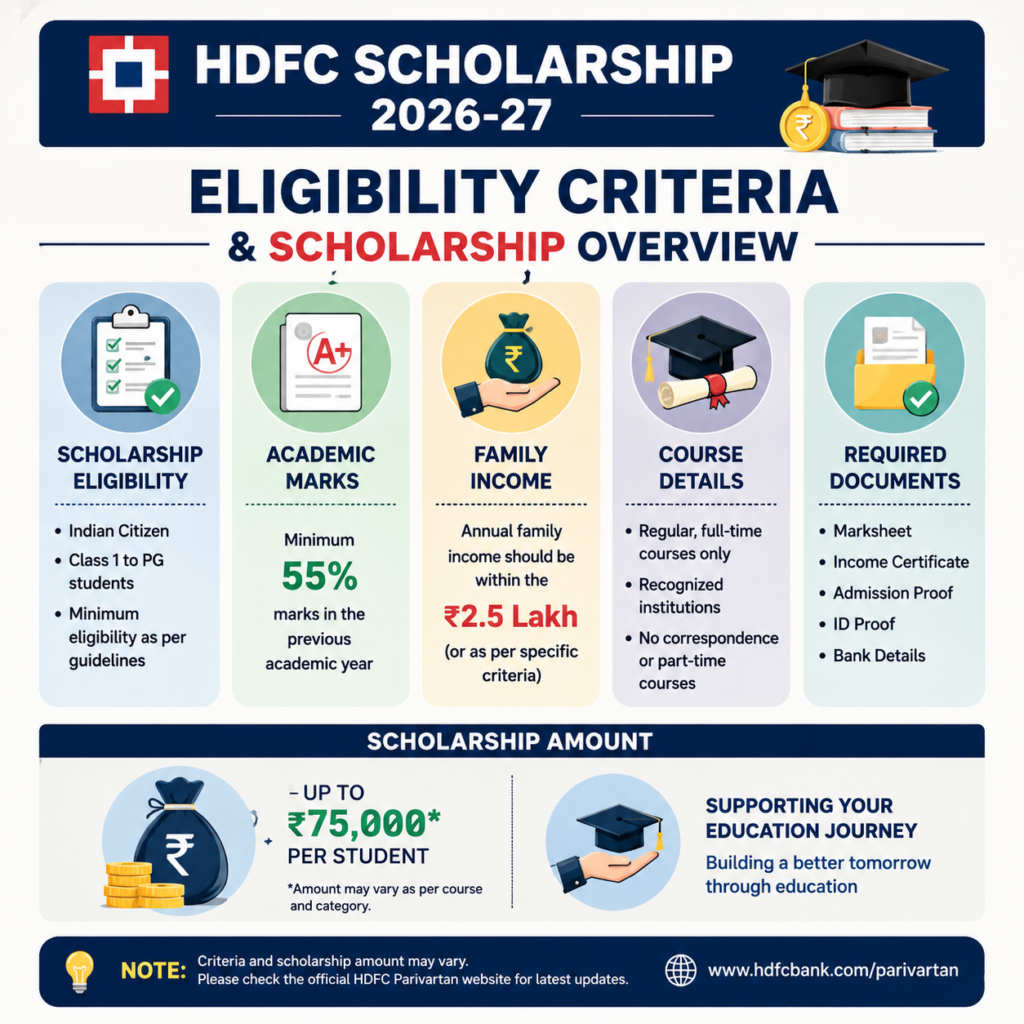
The HDFC Bank Parivartan ECSS Programme is intended for students who are academically capable but face financial difficulties or circumstances that can put their education at risk.
Available programme information for the 2026-27 cycle indicates eligibility generally covers students from school through postgraduate education, with a minimum academic requirement commonly listed at 55% and an annual family-income ceiling of ₹2.5 lakh. However, students should always verify the conditions applicable to their specific category before submitting an application.
The scholarship amount varies according to the level and type of course. Recent programme information lists assistance ranging from ₹15,000 for lower school categories to as much as ₹75,000 for professional postgraduate students.
HDFC Scholarship 2026-27 Last Date
Students searching for HDFC Scholarship 2026 apply online last date should be careful with unofficial dates circulating online.
At the time of writing, publicly available 2026-27 listings show different deadline information, including September and December dates. Because these dates conflict, it is safer not to treat an unofficial date as confirmed until the current application page or official announcement verifies it.
So, if you are planning to apply, don’t wait for the last day. Keep your documents ready and check the live application status before submitting the form.
HDFC Scholarship 2026-27 Apply Online Kaise Kare?
Students searching for hdfc scholarship 2026-27 apply online kaise kare should first identify the current application page for the Parivartan ECSS Programme and read the category-specific eligibility requirements.
The application is generally completed online. Recent programme guidance describes the process through the scholarship application platform, where students register, complete the form, upload documents, review their information and submit the application.
Documents You Should Keep Ready
Depending on your category and circumstances, commonly requested documents can include:
- Recent passport-size photograph
- Previous examination marksheet
- Identity proof
- Current admission proof
- College/school ID or bonafide certificate
- Bank account information
- Income proof
- Proof of personal or family crisis, where applicable
The exact document list can vary by applicant category, so don’t upload an unrelated document simply because another student was asked for it.
HDFC Scholarship Apply Online Process
Step 1: Check eligibility
Confirm your course/class, marks, family income and other applicable requirements.
Step 2: Keep documents ready
Scan documents clearly before starting the application.
Step 3: Register on the application platform
Use your active mobile number and email address.
Step 4: Fill in personal and academic details
Enter your name, date of birth, course, institution, marks and family information exactly as shown on your documents.
Step 5: Enter financial details
Provide accurate information about family income and financial circumstances.
Step 6: Upload documents
Make sure documents are readable and meet the specified format and size requirements.
Step 7: Preview the application
This step is extremely important.
Check:
- Name spelling
- Marks
- Bank details
- Mobile number
- Income information
- Course information
- Uploaded documents
Step 8: Submit the application
Submit only after checking every field.
Step 9: Save the acknowledgement
Take a screenshot or save the application confirmation for future reference.
Step 10: Track your application
Continue checking the application status and your registered communication channels for document-verification or interview-related updates.
HDFC Scholarship Apply Online Step-by-Step Process
| Step | What to Do | Important Tip |
| 1 | Check eligibility | Verify marks, income and course |
| 2 | Collect documents | Keep clear scans ready |
| 3 | Register | Use active contact details |
| 4 | Fill application | Match details with documents |
| 5 | Add financial details | Never provide false information |
| 6 | Upload documents | Check size, format and readability |
| 7 | Preview | Check every important field |
| 8 | Submit | Submit before the deadline |
| 9 | Save acknowledgement | Keep proof of submission |
| 10 | Track status | Watch for verification/interview updates |
How to Prepare for the HDFC Scholarship Interview
The best interview preparation starts with your own application form.
Read the application again before the interview.
If you mentioned an achievement, be ready to explain it.
If you mentioned a financial challenge, know the relevant facts.
If you mentioned a career goal, understand why you chose it.
If you mentioned an extracurricular activity, be prepared to discuss your actual role.
Prepare a 60-second introduction
Practice speaking naturally rather than memorising a paragraph.
Know your academic record
Keep your marks, course name, institution and recent academic achievements clear in your mind.
Understand your financial situation
You may be asked questions about:
- Family income
- Number of family members
- Educational expenses
- Financial difficulties
- Other sources of support
- Why scholarship assistance is important
Answer only what is true.
Prepare your crisis explanation
If your application is connected to a personal or family crisis, explain:
What happened → when it happened → how it affected education → what your family did → why support is needed.
Don’t make the story unnecessarily emotional. Facts are more credible.
Prepare field-related questions
Spend some time reviewing your current course.
A B.Tech student should understand their technical area.
A B.Com student should know important commerce/business concepts.
A medical student should know relevant developments in their field.
A law student should be familiar with current topics relevant to their studies.
Practice unexpected questions
Don’t prepare only the 20 questions listed in this article.
The interviewer may ask a follow-up based on your previous answer.
For example:
Interviewer: Why did you choose this course?
You: Because I enjoy technology.
Interviewer: Which area of technology interests you most?
You should be able to continue the conversation naturally.
What Makes an HDFC Scholarship Interview Answer Strong?
A strong answer is:
- Honest
- Specific
- Short
- Relevant
- Easy to understand
- Based on your real experience
A weak answer is:
- Over-rehearsed
- Extremely long
- Exaggerated
- Contradictory
- Copied from the internet
What If You Don’t Know the Answer?
Don’t panic.
You can say:
“I am not completely sure about that, but I would like to learn more about it.”
For readers who prefer a quick walkthrough, this video explains the full process step by step.
HDFC Scholarship Interview and Application Problems: Common Issues
Not every student who applies will move directly to the interview.
Applications can go through screening and document verification first. HDFC Bank’s impact assessment describes a structured selection process involving shortlisting, document verification, personal interviews and final selection.
That means students should treat the application form seriously. An impressive interview cannot correct inaccurate information submitted in the application.
1. Interview call has not arrived
Don’t immediately assume that your application has been rejected.
The application may still be under review or document verification.
Check your application status and registered communication channels.
2. Documents are unclear
If a document is blurry, cropped or unreadable, it can create verification problems.
Use a clear scan or photograph and check the complete document before uploading.
3. Information in the application doesn’t match documents
For example:
- Different spelling of name
- Incorrect marks
- Wrong course
- Incorrect income information
Always compare the application with your original documents before submission.
4. You are nervous during the interview
Nervousness is normal.
Take a second before answering. Speak slowly and focus on one question at a time.
5. You don’t know an answer
Don’t invent an answer.
Say that you are unsure and, where appropriate, explain what you do know.
6. Your financial situation is complicated
Explain it clearly using facts.
Avoid giving contradictory figures about income, expenses or family circumstances.
7. You have no major extracurricular achievements
That’s okay.
Scholarship interviews are not a competition to see who has the longest certificate list.
Focus on academic progress, genuine responsibilities, challenges overcome and your goals.
HDFC Scholarship Problems vs Solutions
| Problem | What You Should Do |
| Interview call not received | Check application status and registered contact details |
| Nervous during interview | Pause, breathe and answer one question at a time |
| Don’t know an answer | Be honest instead of guessing |
| Document unclear | Upload a clear and complete copy if resubmission is allowed |
| Application information incorrect | Follow the available correction/update process |
| Financial details difficult to explain | Prepare a simple factual explanation |
| No big achievements | Discuss genuine academic progress and responsibilities |
| Career goal unclear | Prepare a realistic short- and long-term plan |
| Unexpected question | Think before answering; don’t rush |
| Asked why you deserve the scholarship | Explain need, commitment and future plans |
NSP Scholarship 2026-27 Apply Eligibility: Check Criteria
HDFC Scholarship Interview Questions 2026-27 – Short Answer
HDFC Scholarship interviews may ask about your introduction, academic performance, financial situation, achievements, career goals, challenges, scholarship need and how the scholarship will support your education. Answer honestly, keep responses specific and avoid memorising scripted answers.
FAQ
What questions are asked in the HDFC Scholarship interview?
Questions can cover your introduction, academic performance, financial circumstances, achievements, career plans, challenges, field of study and why you need the scholarship.
How should I answer “Tell me about yourself” in an HDFC Scholarship interview?
Give a short introduction covering your name, current class/course, academic background, relevant achievement and career goal. Keep it natural and truthful.
Why does HDFC Scholarship ask interview questions?
The interview is part of the selection process and can help assess whether the applicant’s academic background, financial circumstances and scholarship need are genuine. HDFC’s impact assessment confirms that personal interviews form part of the selection process.
What should I say if I don’t know an interview answer?
Don’t guess or make up information. Politely say that you are not completely sure and, if possible, explain what you do know.
What should I prepare before the HDFC Scholarship interview?
Review your application, marksheets, financial information, achievements, course details, career goals and any personal or family circumstances mentioned in your application.
Is the HDFC Scholarship interview difficult?
The questions are generally designed around your application and circumstances rather than being a conventional competitive examination. A recent HDFC ECSS scholar interview described the questions as moderate and focused mainly on academic and financial circumstances.
Conclusion
Getting ready for the HDFC Scholarship Interview 2026-27 is not about learning impressive sentences by heart. The most important thing is to understand your own application and be able to explain your education, financial circumstances, achievements and future goals honestly.
Before the interview, review your documents, prepare a short introduction, think about the challenges you have overcome and understand exactly how the scholarship would help you continue your education. If an unexpected question comes up, don’t rush. Take a moment, think and answer honestly.
For students searching for HDFC Scholarship 2026-27 apply online kaise kare or the HDFC Scholarship 2026 apply online last date, the safest approach is to keep checking the current application information rather than relying on old or conflicting dates.
Most importantly, remember that the interview is your opportunity to explain your real story. You don’t need a perfect English accent or a memorised speech. Be genuine, be clear and let the interviewer understand why continuing your education matters to you.



One Response